Quercus rubra
Northern Red Oak
The open-pored half of the oak woods: the benchmark American flooring hardwood, the group a scaler separates before he quotes a price, and the oak that oak wilt can kill in a single season.
Also called: Red oak, gray oak, eastern red oak - and on a scale ticket the whole red oak group: southern red, cherrybark, black, scarlet, pin, water, and willow oak
- Native range
- Nova Scotia to Alabama, west to Minnesota and Oklahoma
- Mature size
- 65-100 ft, 2-3 ft diameter, larger on cove sites
- Janka hardness
- 1,290 lbf
- Status today
- Abundant; oak wilt and poor regeneration are the working problems
Old Meaning
One word, two families, and the split that prices your timber
Every oak east of the Plains falls into one of two working groups, and the split is old country knowledge before it is botany. White oak group: rounded leaf lobes, acorns that ripen in one season, and wood whose pores are plugged shut from the inside. Red oak group: leaf lobes tipped with a bristle, acorns that take two seasons to ripen, and pores that run open from one end of a board to the other. Northern red oak is the namesake and the benchmark of the second group - the tree the rest of the group is graded against on every scale ticket in the East.
The open pores are the whole personality of the wood, and there is an old demonstration that makes the point better than a textbook: cut a foot of green red oak branch, put one end in a bucket of water, and blow through the other. Bubbles. Do the same with white oak and you get nothing, because tyloses seal the vessels. That party trick is why a red oak barrel will not hold whiskey, why red oak fence posts rot while white oak posts stand, and why the two groups have never sold for the same money.
The acorns carried the tree's older meaning. Red oak acorns are heavy in tannin - bitter enough that deer, turkey, and bear work through the sweeter white oak mast first and turn to red oak acorns in late fall and winter, when everything else is gone. Because the crop takes two years to ripen, a red oak ridge carries some acorn crop even in a year the white oaks fail, which is exactly the kind of insurance a wintering deer herd - or a settler's free-ranging hogs - lived on. People ate them too, leached in running water the way the tannin demanded.
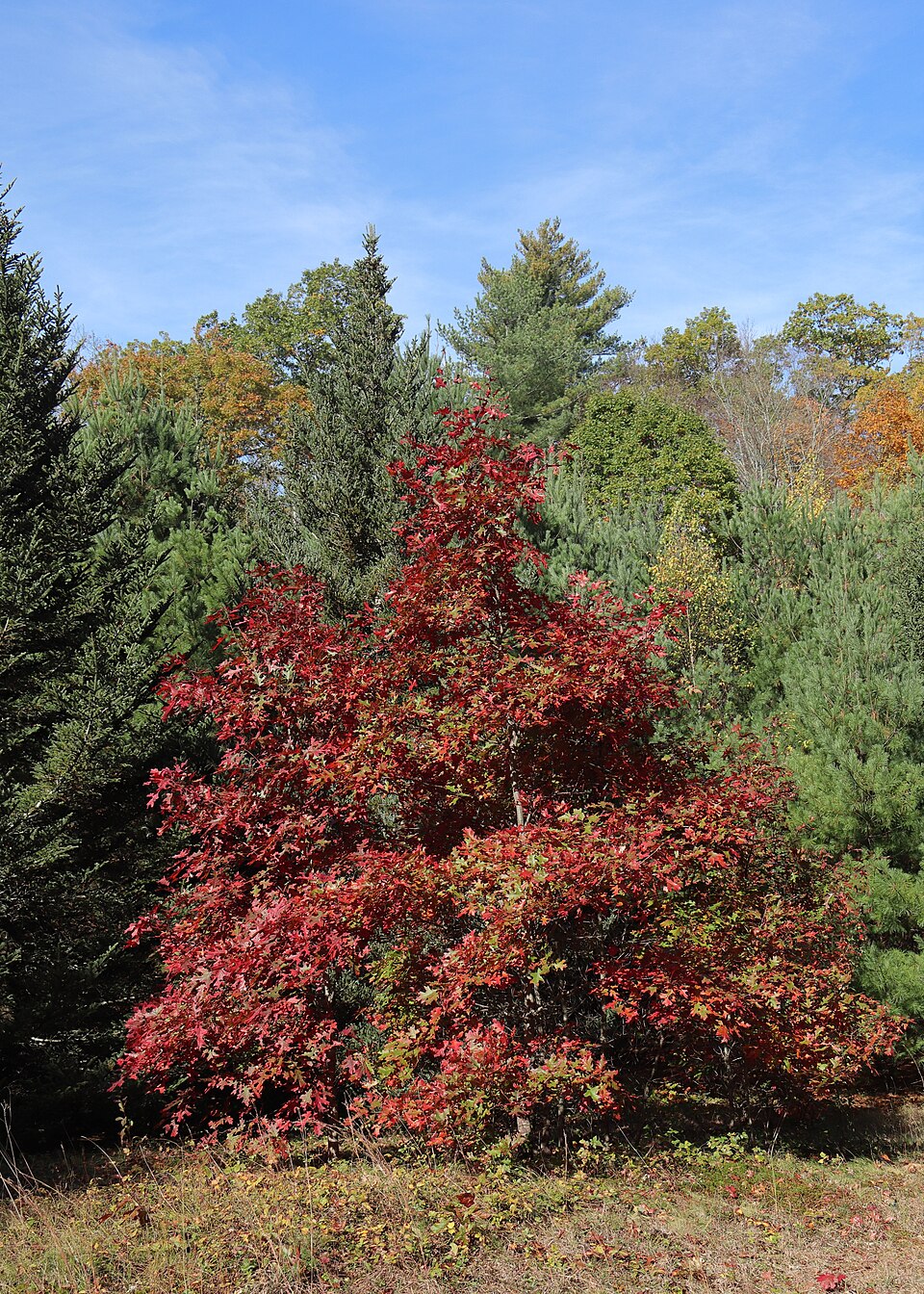
On the homestead it was the firewood standard and the everything-wood: straight-splitting, dense, and everywhere. Survey records across the East name red oak as a witness tree at corner after corner, for the same unromantic reason white oak got the job - it was big, common, and long-lived enough for the next surveyor to find. The name itself is the least mysterious part: the fall color runs wine-red, and the fresh-cut heartwood carries a pink-red cast the trade still sorts boards by.
Documented History
The floor of the postwar house, and a fungus moving underground
Red oak's American century is the twentieth. When the postwar housing boom built out the suburbs, two-and-a-quarter-inch red oak strip flooring was the default floor of the American house, and for a generation the species was less a tree than a building material - cut, graded, kiln-dried, and nailed down by the trainload. The furniture and cabinet industries ran on it in parallel, and the golden-oak look of the 1980s and 1990s was mostly this tree. Fashion has since swung toward white oak and paler woods, and red oak grade prices have softened relative to its cousin - a reversal a landowner selling mixed oak should know about before he averages the two in his head.
The disease chapter is current, not historical. Oak wilt - a vascular fungus now named Bretziella fagacearum - was first identified in Wisconsin in the 1940s and has since been documented across the Midwest, the lake states, Texas, and much of the Appalachian range. It kills through the tree's own water system, and it treats the two oak groups very differently: white oaks often fight it limb by limb for years, while a red oak group tree typically wilts from the top and dies within weeks to a single season. The fungus moves two ways - overland by sap beetles drawn to fresh wounds, and underground through root grafts, because neighboring red oaks plumb their roots together.
That biology produces the two rules every extension service in oak country publishes: do not wound or prune oaks in spring and early summer when the beetles fly, and do not move unseasoned oak firewood out of an infected county. Neither rule is AXE USA's invention and both are worth reading in the original - the sources at the bottom of this page include one.
The quieter problem in the background is regeneration. Across much of the East, mature oak stands are not replacing themselves: decades of fire exclusion favor shade-tolerant maple and beech in the understory, and heavy deer browse takes the oak seedlings that do start. Foresters call the pattern mesophication, and it means the oak woods a landowner inherited are not automatically the woods his grandchildren will inherit. It is a management question - shelterwood cuts, fire where it can be used, browse control - and it is the reason a harvest plan for an oak ridge should think past the harvest.
Medicinal Record
Tannin, bark tea, and a yellow dye out of the same barrel
Read this first
What follows is a record of what people used and what published sources documented - nothing more. It is not medical advice, it is not a recommendation, and no plant on this page is a treatment for anything. Several of these trees are toxic to livestock and some are toxic to people. Do not eat, brew, or dose anything based on a history page. Talk to a physician, and talk to a veterinarian before your animals get near any of it.
The oak entry in the American medical record is a bark entry, and the active word is tannin. Ethnobotanical compilations document red oak inner bark decoctions across Native American practice - washes for skin complaints, gargles for sore throats and mouths, astringent preparations against dysentery - and nineteenth-century domestic medicine carried oak bark for the same purposes, usually preferring white oak but using the red oak group where it stood. All of it worked, to the extent it did, by the same blunt chemistry: tannin binds and tightens tissue. It was pharmacy by astringency, it is reported here in the past tense, and none of it has a place in modern practice.
The most commercially important thing ever extracted from a red oak group bark was not a medicine at all. Quercitron - the inner bark of black oak, Quercus velutina, a red oak group member - yielded a strong yellow dye that Edward Bancroft patented in 1785, and it dyed wool and cotton on two continents for a century until synthetic dyes ended the trade. It belongs in this section because it is the same story as the bark medicine: the red oaks were a chemical crop before they were a lumber crop, and the chemical was in the bark, not the wood.
The tannin that made the bark useful is also the livestock warning. Oak poisoning in cattle is a documented veterinary event, not folklore: heavy feeding on oak buds after a spring storm drops limbs into a pasture, or on green acorns in a drought fall, produces tannin-driven kidney damage that extension veterinary services describe in detail. A pasture full of storm-downed oak tops is a real hazard. That is a conversation for a veterinarian, and the point of raising it here is only that a landowner felling oak beside grazing land should know the conversation exists.
Timber & Owner Value
The volume grade hardwood on most Eastern ground
What a mill buys from a red oak stand is grade, and grade lives in the butt log. Clear faces - bark surface free of knots, seams, and catfaces on the first ten to sixteen feet - are what separate a flooring and cabinet log from a crosstie log, and the sort that happens on the log deck is where that separation turns into two different prices, and the veneer buyer wants cleaner still: straight, round, centered heart, no shake. Below grade, red oak goes to ties, pallet cants, and blocking, and there is no shame in tie money - a great deal of red oak was born to be a crosstie. Agency mill listings almost never break oak out by species, so the Arkansas, Georgia, and Wisconsin directories - the three that publish species detail - are the closest thing to a map of who actually runs this wood. The spread between those products, log by log out of the same tree, is where the value of a red oak sale is actually decided.
The wood itself is the American benchmark hardwood for a reason: 1,290 pounds-force on the Janka scale, coarse handsome open grain that machines cleanly and takes stain evenly, and enough hardness for a floor without being brutal on tooling the way hickory is. Its one absolute limit follows from those open pores - red oak has little decay resistance and belongs indoors. Every red oak crosstie under a railroad is pressure-treated to get around that; an untreated red oak post is a short-term post.
Then there is the pool. "Red oak" on a scale ticket is not a species, it is a group of eight or more, and they do not deserve the same money: cherrybark oak off a bottomland ridge is the best red oak in the South and sells like it, northern red off a cove site is the benchmark, and water oak, willow oak, and storm-grown southern red from an old pasture are usually tie-grade trees wearing the same name. A cruise that lumps them as "red oak" hands the buyer the sorting profit. A cruise that separates them keeps it - and the same log run through Doyle, Scribner and International shows you how much of the spread is the rule and how much is the tree.
Two timing points pay for themselves. First, oak wilt is a selling clock: a red oak that dies in July is losing grade by October, as stain and borers move in, and because the fungus crosses root grafts, one dead tree in a red oak pocket is a reason to walk the whole pocket with a forester. Second, red oak is the volume species in most mixed-hardwood sales, which means it sets the tone of the whole bid - and a single door-knock offer on a mixed oak tract is priced against nobody. Put the tract out to sealed bid so several buyers have to price it blind against a deadline, and let the white oak, the cherrybark, and the tie logs each find their own money.
The wood, by the numbers
- Janka hardness
- 1,290 lbf
- Specific gravity (12% MC)
- 0.63
- Heartwood decay resistance
- Low - an indoor wood; posts and ground contact are white oak's job
- Workability
- Machines cleanly; coarse open grain takes stain evenly
- Products
- Flooring, cabinets, grade lumber, veneer, crossties, pallets
- The pool
- 8+ species sell under the one name - separate them before you price them
Where this leads
History is worth knowing on its own. If it turned into a question about the timber on your own ground, these are the tools that answer it.
Put a red oak tract out to sealed bids
Red oak sets the tone of most mixed-hardwood sales, and one walk-up offer is priced against nobody. Post the tract once, set a deadline, and buyers bid sealed - the cherrybark, the white oak, and the tie logs each find their own money. Free to post.
Open itFind a consulting forester or a mill
A cruise that separates northern red from water oak - and red oak from white - is the single cheapest thing you can do before a sale. The directory lists foresters, mills, and buyers by what they do and where they work. These are self-listed businesses; call them and judge for yourself.
Open itPrice the acorns, not just the logs
A red oak ridge carries mast in years the white oaks fail, and wintering deer know it. If the timber is not ready to cut, the ground under it can still earn - hunting leases list by state, acreage, and game.
Open itWhere this came from
AXE USA publishes no research of its own. Everything on these pages is read out of USDA Forest Service, USDA NRCS, land-grant extension, and published historical sources, each linked at the bottom of the page so you can go read the original.
- Silvics of North America, Vol. 2: Quercus rubraUSDA Forest Service
- Fire Effects Information System: Quercus rubraUSDA Forest Service
- Oak wilt in Minnesota (identification, spread, and the pruning calendar)University of Minnesota Extension
- Wood Handbook: Wood as an Engineering Material (FPL-GTR-282)USDA Forest Products Laboratory