Carya spp. - shagbark, shellbark, mockernut, pignut
Hickory
The hardest, toughest working wood in the Eastern forest - the handle in every axe, the smoke on every rib, and the nickname a president wore as a compliment.
Also called: The true hickories on a grade sheet; the pecan hickories (pecan, bitternut, water hickory) sell in the same pool under the same name
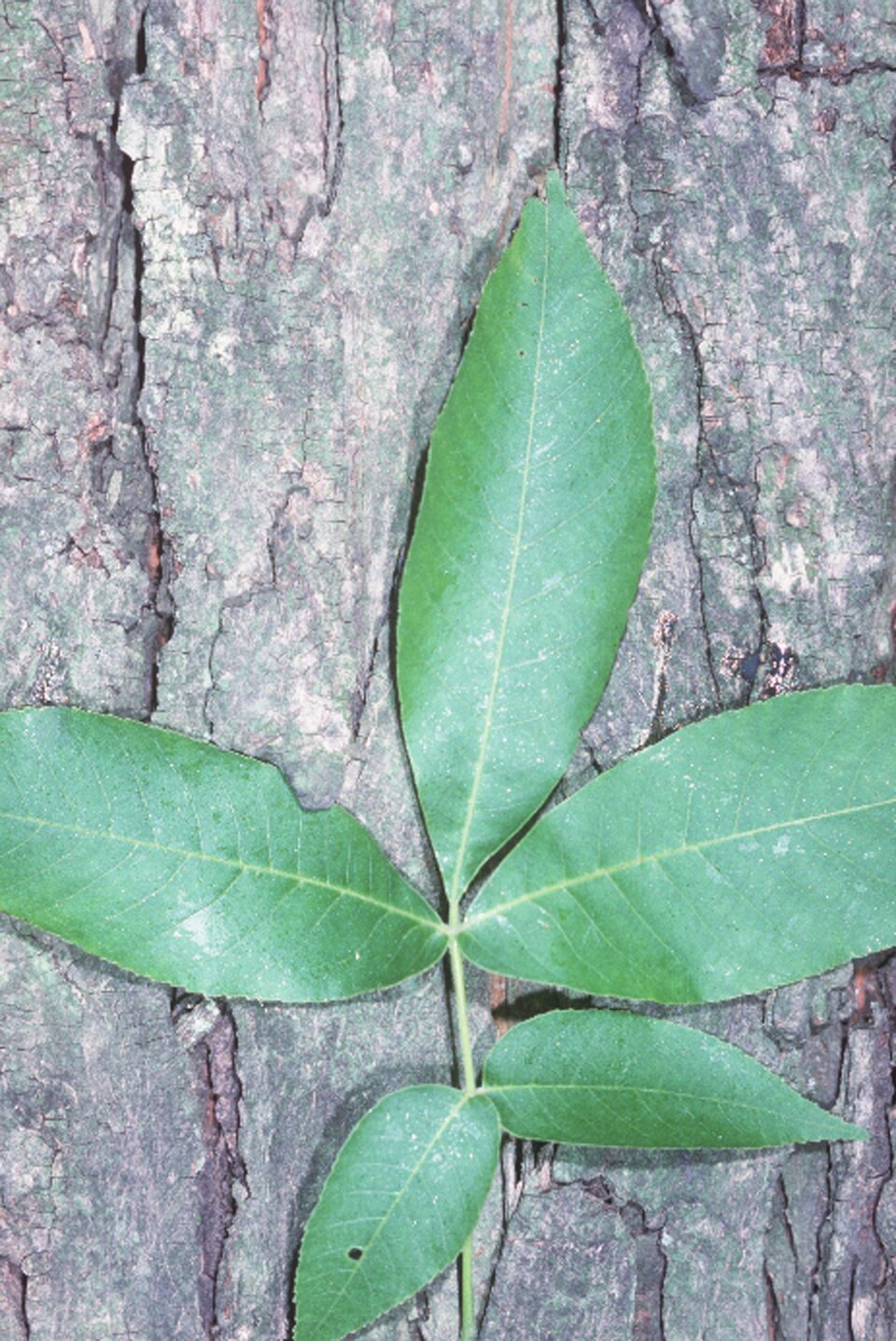
- Native range
- The whole East - dry ridges to river bottoms, by species
- Mature size
- 60-100 ft, slow-grown, deep-rooted
- Janka hardness
- 1,820 lbf (shagbark) - the common-species ceiling
- Status today
- Abundant; more often underpriced than scarce
Old Meaning
Pawcohiccora, Old Hickory, and the toughest thing a soldier knew
Hickory is one of the few trees whose English name came whole out of an American language. Pawcohiccora was the Virginia Algonquian word for the milky food pounded and boiled from hickory nuts, and colonial writers wore it down to hickory within a generation. The food itself is documented, not reconstructed: William Bartram, traveling the Southeast in the 1770s, described Creek towns holding stores of shellbark hickory nuts by the hundred bushels and straining the pounded meats into a rich, cream-like liquor for cooking. The tree fed people at scale before it ever swung a hammer.
The name's second life is political and it is the best one-word review a wood ever got. Andrew Jackson's soldiers on the 1813 march home from Natchez called him Old Hickory because he was the toughest thing they had a word for, and the country understood the compliment instantly - by then hickory was already the American byword for something that bends without breaking and wears out everything sent against it. Hickory shirts, hickory switches, tough as hickory: the tree became an adjective, and the adjective elected a president's image.
On the farm it was the striking-tool wood, full stop. Axe, sledge, hammer, hoe, pick, froe maul - if a tool had to take shock through a handle, the handle was hickory, because nothing else common combined the strength, the stiffness, and the ability to absorb impact without shattering. Wagon spokes, hubs, and axles came off the same trees, and the smokehouse burned the tops: hickory-smoked meat started as the flavor of what the woodlot happened to have, and stayed because nothing else tasted right.
The nuts kept their own ledger. Shagbark and shellbark are sweet and worth the cracking, mockernut is mostly shell around a thimble of meat - the name is the review - and pignut runs from decent to bitter tree by tree. As mast, the genus matters the way oak does: a ridge with good hickory on it feeds deer, turkey, and squirrels on a schedule that stacks with the acorn crop, which is an asset a hunting-lease listing can say out loud.
Documented History
Handle mills, golf shafts, and a wood that never got to be fancy
The industrial history of hickory is the history of the handle. Through the late nineteenth and twentieth centuries, handle mills across Tennessee, Kentucky, Arkansas, and the surrounding states turned Southern hickory into the striking-tool handles of the world - an export trade, not just a domestic one, because no other temperate wood matched the combination. The Forest Products Laboratory's own handbook states it plainly: the true hickories rank among the highest of any commercial American wood in the combined measures of strength, hardness, stiffness, and shock resistance. That sentence, in drier language, is the whole industry.
The sporting chapters are shorter and stranger. Golf was played on hickory shafts until steel shafts won approval in the 1920s, and the modern revival game still calls itself hickory golf; the wood also did duty in skis, ladder rungs, wagon rims, and the sucker rods that worked early oil and water wells. Today its most audible job is the drumstick - hickory remains the standard material because it absorbs stick shock the same way it absorbed axe shock for two centuries.
What hickory never became is a glamour wood, and the record shows why: it is brutal on saw teeth and knives, it shrinks hard in drying and will check, warp, and honeycomb in a kiln run that gentler species forgive, and its grain and color were long considered too busy for fine furniture. So the price history rides function - handles, flooring, pallets, ties - rather than fashion, with one modern exception: rustic and character-grade hickory flooring became a genuine market, and barbecue turned hickory chunks, chips, and splits into a retail product with a price per pound.
The health of the resource is good but not untouched. The hickory bark beetle kills drought-stressed trees in pulses across the range - Forest Service pest literature documents the pattern - and standing dead hickory sheds its enormous limbs fast, which makes beetle-killed trees a felling hazard worth naming. There is no hickory blight and no hickory borer emergency; the genus's problem in the woods is the quieter oak-family one, regeneration under fire exclusion and deer browse.
Medicinal Record
A food record wearing a medicine label
Read this first
What follows is a record of what people used and what published sources documented - nothing more. It is not medical advice, it is not a recommendation, and no plant on this page is a treatment for anything. Several of these trees are toxic to livestock and some are toxic to people. Do not eat, brew, or dose anything based on a history page. Talk to a physician, and talk to a veterinarian before your animals get near any of it.
Honesty first: hickory's medical record is thin, and this page is not going to pad it. The ethnobotanical compilations list scattered Native American uses - bark preparations taken for aches and as dressings, shoot and bark infusions in a handful of tribal records - but there is no hickory equivalent of willow bark's aspirin trail or the tulip-poplar's wartime fever service. What the record overwhelmingly shows instead is food: pawcohiccora, the nut stores Bartram counted, hickory milk in the cooking of the Southeast. When a tree is this useful as material and calories, the folk record leans there, and the honest summary of hickory medicine is that hickory was dinner.
The one preparation with a modern following - shagbark syrup, made by toasting the loose bark plates and infusing the extract into sugar syrup - is a flavor product, not a remedy, and a twentieth-century invention besides. It earns its sentence here only to mark the line: nothing about it is medicinal, historical, or a reason to strip bark off a living tree that is holding its grade for a future sale.
The cautions attached to this genus are physical rather than chemical. No notable livestock toxicity follows hickory in the veterinary extension record - useful news for a species this common on pasture edges - but dead and beetle-killed hickory drops massive limbs with little warning, and green hickory is heavy, tension-loaded wood that behaves badly under a bar for the unprepared. The felling conversation belongs with an insured professional; the animal conversation, as always on these pages, belongs with a veterinarian.
Timber & Owner Value
Averaged down in the pool, and how to keep it from happening
Know what the buyer means before you nod: "hickory" on a scale ticket is a pool. The true hickories - shagbark, shellbark, mockernut, pignut - carry the strength numbers the handle and flooring markets pay for; the pecan hickories - pecan, bitternut, water hickory - are honest wood sold under the same name at a discount, and orchard-grown pecan adds the embedded-metal problem that gets whole loads rejected. A cruise that says 'hickory, 40 MBF' has told you less than it seems; a cruise that splits true from pecan hickory has told you what the tract is worth. Hickory is one of the few species agency mill directories name at all - Arkansas, Georgia, and Wisconsin publish it - and everywhere else it is filed under hardwood and you find the handle and flooring buyers by phone.
The grade products are specific. Handle stock still exists as a market and historically wanted white wood - the sapwood, in hickory's case, a reversal of most species' preference - clear of knots and birdpeck. Character and rustic flooring took over much of the top of the market and tolerates the color mix the handle trade docked. Below that sit ties, pallet cants, and blocking, and beside all of it sits the barbecue trade, which buys chunks, splits, and chips - a real outlet for tops, culls, and small stems that most landowners give away with the logging slash. Hickory also sits at the top of the firewood BTU tables, which is the other reason the cull pile is worth more than the slash pile it usually joins.
The wood's numbers explain both the demand and the mill's caution: 1,820 pounds-force Janka for shagbark, specific gravity around 0.72, and the handbook's benchmark shock resistance. The same density makes it expensive to saw and treacherous to dry - degrade in the kiln is the mill's risk, and mills price that risk into what they pay at the gate, which is what happens to a log after the deck in one sentence. Decay resistance is low; hickory is an inside-and-in-hand wood, not a post.
The selling pattern to defend against is the average. Hickory rarely headlines a sale; it rides along in mixed-hardwood tracts, and a lump-sum buyer quietly averages it toward tie money even when the ridge is full of straight shagbark that a handle or flooring buyer would bid up. The counter is the same one that runs through every page in this section: separate it on the cruise, say it in the listing, and make more than one buyer put a sealed number on it. Getting there is the same sequence for every species - what a timber sale looks like start to finish - and if the tract hunts, count the mast, because a hickory-and-oak ridge is a wildlife feature a lease listing can price.
The wood, by the numbers
- Janka hardness
- 1,820 lbf (shagbark)
- Specific gravity (12% MC)
- 0.72
- Shock resistance
- The benchmark - highest combination among common US woods
- Heartwood decay resistance
- Low - an inside and in-hand wood
- Products
- Handles, flooring, ladder rungs, ties, charcoal, smoking wood
- The mill's caution
- Hard on tooling and dries with degrade - priced accordingly
Where this leads
History is worth knowing on its own. If it turned into a question about the timber on your own ground, these are the tools that answer it.
Keep hickory out of the average
Lump-sum buyers average hickory toward tie money in mixed sales. Post the tract once, name the shagbark in the listing, set a deadline, and let handle, flooring, and tie buyers each put a sealed number on it. Free to post.
Open itFind a consulting forester or a mill
A cruise that splits true hickory from pecan hickory - and grade stems from tie stems - is what keeps the pool from pricing your ridge. The directory lists foresters, mills, and buyers by what they do and where they work. Self-listed businesses; call them and judge for yourself.
Open itPrice the mast while the timber grows
A hickory-oak ridge feeds deer, turkey, and squirrels on a schedule that stacks with the acorn crop. If the stand needs another decade, the ground under it can earn now - hunting leases list by state, acreage, and game.
Open itWhere this came from
AXE USA publishes no research of its own. Everything on these pages is read out of USDA Forest Service, USDA NRCS, land-grant extension, and published historical sources, each linked at the bottom of the page so you can go read the original.
- Silvics of North America, Vol. 2: Carya ovata (shagbark hickory)USDA Forest Service
- Fire Effects Information System: Carya ovataUSDA Forest Service
- Travels Through North & South Carolina, Georgia, East & West Florida (Bartram, 1791)Internet Archive
- Wood Handbook: Wood as an Engineering Material (FPL-GTR-282)USDA Forest Products Laboratory