Quercus alba
White Oak
One anatomical quirk - pores plugged shut from the inside - built the wooden navy, and it still puts every drop of bourbon in the country inside a brand new barrel.
Also called: Stave oak, ridge white oak - and on a scale ticket the whole white oak group: post oak, swamp chestnut oak, chinkapin oak, bur oak, overcup oak
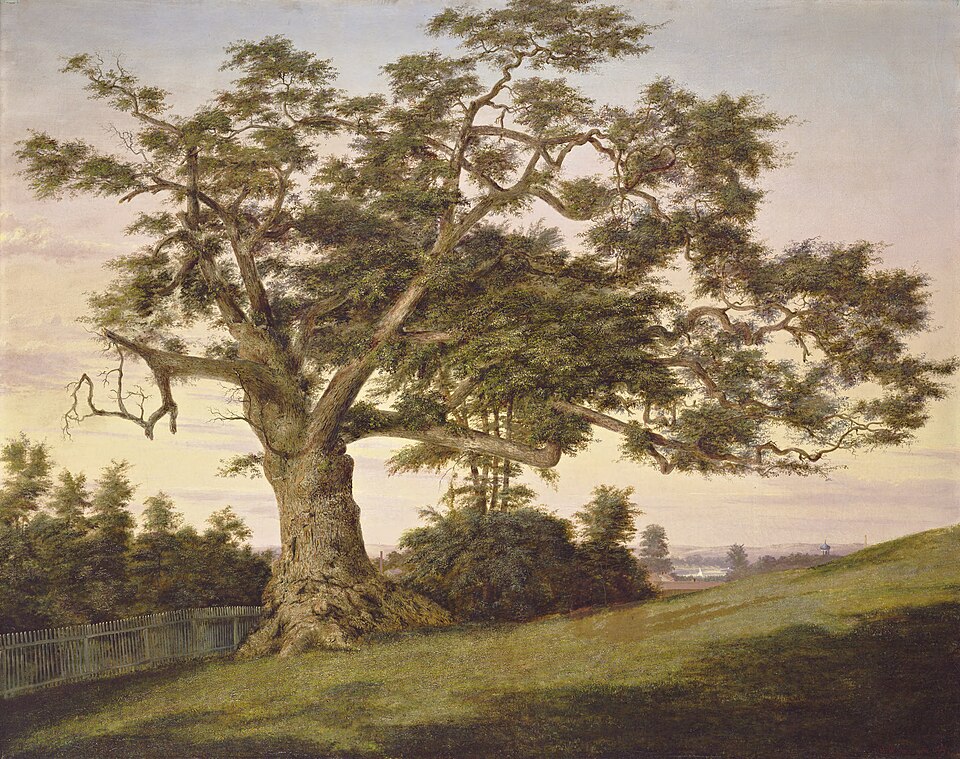
- Native range
- Maine to north Florida, west to Minnesota and east Texas
- Mature size
- 60-80 ft, over 100 on good sites, 2-4 ft diameter
- Janka hardness
- 1,350 lbf - the hardwood benchmark
- Status today
- Abundant; regeneration is the management problem
Old Meaning
The tree left standing in the middle of the field
Find a white oak that grew in the open and you can read the history of the field off the tree. An open-grown white oak has a short, thick trunk and enormous limbs running out nearly level, because it never had to race anything for light. A forest-grown white oak of the same age is a tall clean pole with its crown fifty feet up. Same species, two different trees, and the difference tells you whether there was pasture around that trunk when it was young.
Trees like that stayed because somebody kept them: shade for stock in July, a corner a survey could be tied to, a landmark you could give directions from. White oak was a standard witness tree in the eastern land records, the blazed corner in a metes-and-bounds description, and it got that job for the least romantic reason available. It lives long enough that the corner is still findable when the grandson goes looking. It commonly reaches 60 to 80 feet, tops 100 feet and 5 feet through on a good site, grows slowly the whole way, and by Forest Service accounts can live 600 years.
The most famous individual white oak in the country was one of those landmarks. The Charter Oak stood in Hartford, Connecticut, until a storm took it down in August 1856, and tradition holds that Connecticut's 1687 royal charter was hidden in its hollow trunk to keep it from Governor Andros. The charter episode is history; the hollow trunk is tradition layered on afterward, and this page is not going to sell it as fact. What is not in doubt is what the tree was - a white oak on a green, treated as a public monument by a town younger than the tree.
The other half of what the species meant is what it fed. White oak sits in the white oak group, whose acorns mature in a single season, and its acorns are low in tannin: Forest Service figures put them generally between 0.5 and 2.5 percent, which in plain terms means sweet. Deer, turkey, black bear, wood ducks, and squirrels take them ahead of red oak acorns when both are on the ground, and mountain families turned hogs into the timber every fall for the same reason. People ate them too, leached of what tannin there was. Heavy crops come roughly every four to ten years, so a stand with white oak in it has fat falls and lean ones.
Documented History
Watertight: the ships first, the barrels ever since
Everything white oak has been worth commercially comes out of one anatomical detail. Oaks are ring-porous - a row of big open vessels in the earlywood of every ring - and in the white oak group those vessels get plugged as the wood ages by balloon-shaped ingrowths called tyloses. Water cannot travel through them. Red oak has no such plugs, which is why a short length of red oak will blow bubbles like a straw and a piece of white oak will not. Plugged pores are rot resistance, and plugged pores are watertight. Ships and barrels are the same property put to work twice.
In the age of wooden ships that made white oak the working timber of American yards: keels, planking inside and out, framing, and the fastenings. Treenails, said and usually written trunnels, are wooden pins driven through plank into frame; they swell against their own holes when wet and never weep rust down a hull the way iron does. The export trade ran on the same wood, riven stave stock and ship timber leaving Chesapeake and New England ports by the cargo, and one of white oak's old common names in Forest Service records is simply stave oak.
USS Constitution is the ship everyone names, and she repays being precise about. Launched at Boston in 1797, she was one of six frigates authorized in 1794 to be the core of the new Navy. Her frames - the ribs - were southern live oak, Quercus virginiana, cut on the Georgia sea islands: a wood so dense, and so given to short crooked limbs, that nothing else on the continent matched it for framing stock. White oak did the keel, the planking, and much of the rest of the structure. The decks were longleaf pine and red cedar went in as well. Framed and planked the way she was, the hull at the waterline came to more than twenty inches of solid timber.
On 19 August 1812, several hundred miles off Nova Scotia, she met HMS Guerriere. British shot struck that hull and failed to get through it, and the account that came off the ship afterward - a sailor shouting that her sides were made of iron - handed the Navy its oldest nickname. Guerriere was dismasted and burned. Constitution is still commissioned and still afloat in Boston, which is why her timber list is a matter of record rather than an argument.
The trade behind the ships was bigger than the American Navy. Britain built on English oak, Quercus robur, the hearts of oak of the song, and one ship of the line ate mature oak by the thousands of trees on a rotation no admiralty could plant its way out of. That pushed the Royal Navy toward Baltic timber, toward North American oak bought by the cargo, and eventually toward teak. American white oak staves and ship timber were a standing export to Europe for two centuries. Then it ended fast: iron-hulled warships arrived in the 1860s, steel followed, and by the last quarter of the century the naval market for oak was gone for good.
The barrel never went anywhere, and the barrel is where the money still is. Tight cooperage - a cask meant to hold liquid rather than dry goods - needs a wood that will not leak, and the white oak group is the only common American hardwood that qualifies, for the same tyloses reason it kept a hull dry. Federal regulation takes it past tradition: to be labelled bourbon, the whiskey has to be stored in a new charred oak container, so every bourbon barrel in this country holds bourbon exactly once, then goes on to Scotch, rum, tequila, and wine producers or gets cut up for furniture. The Forest Service's own species review calls white oak the major source of wood for whiskey barrels. That demand is why stave logs are quoted as their own product instead of disappearing into your grade sawlog volume.
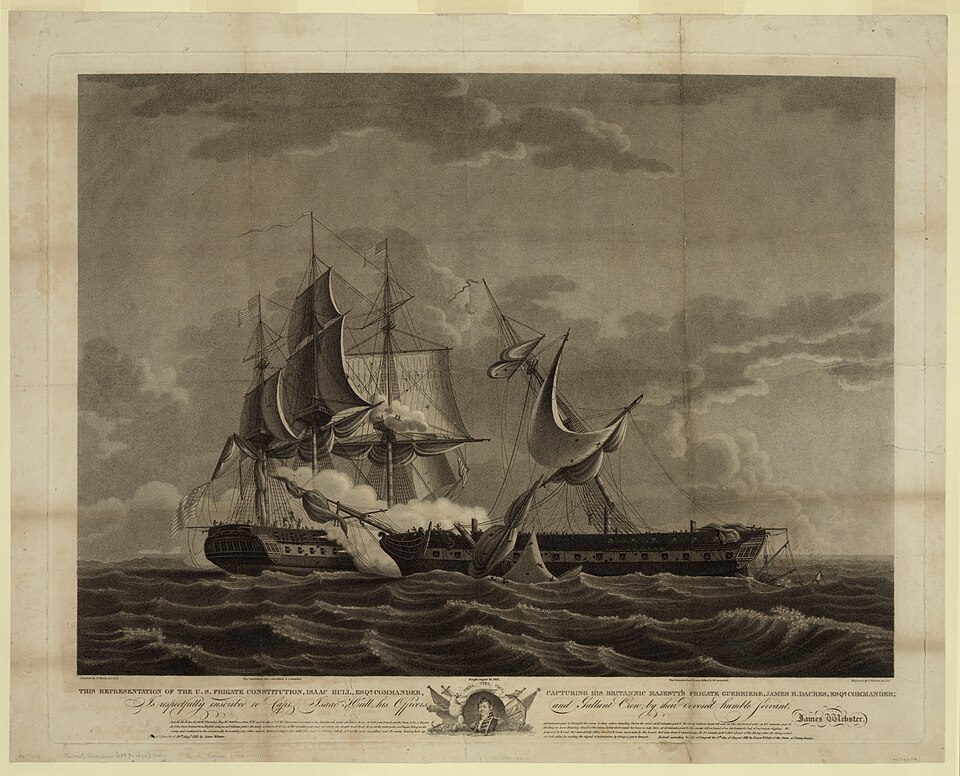
Constitution and Guerriere, 19 August 1812 - engraved by Cornelius Tiebout after a painting by Thomas Birch and published the following year. British shot bouncing off that hull is where the name Old Ironsides comes from, and the frames doing the work were live oak.
Cornelius Tiebout after Thomas Birch (1813). Library of Congress Prints and Photographs Division. Public domain.
Medicinal Record
Bark, tannin, and what the published record actually says
Read this first
What follows is a record of what people used and what published sources documented - nothing more. It is not medical advice, it is not a recommendation, and no plant on this page is a treatment for anything. Several of these trees are toxic to livestock and some are toxic to people. Do not eat, brew, or dose anything based on a history page. Talk to a physician, and talk to a veterinarian before your animals get near any of it.
White oak's place in the documented herbal record is the bark, and the property at issue was astringency. Oak bark is heavy in tannins - the same compounds that made it an industrial material for tanning leather - and the astringent effect on tissue is what every recorded use rested on.
The USDA NRCS plant guide for the species sets out the ethnobotanical history, and nineteenth-century American pharmacy carried Quercus alba bark on the same grounds: an astringent, prepared as a decoction of the bark, applied externally as a wash and used as a gargle. It sat in the dispensatories of that period alongside the other tannin-bearing barks and left mainstream practice as those texts were superseded. Published sources report that history. They do not report a clinical basis for it, and nothing on this page states that the bark does anything at all.
Two things get folded into this record that do not belong in it. Tanning hides with oak bark was an industry rather than a medicine, and it belongs with the timber further down the page. And the tannin in acorns is why acorns were leached in water before anyone ate them - Forest Service figures put white oak acorn tannin at roughly 0.5 to 2.5 percent, low for an oak, which is exactly why this species' acorns were the ones worth gathering.
Timber & Owner Value
Stave logs, grade logs, and everything under that
One white oak can leave the woods as four products at four prices, and sorting out which is which is most of what a landowner controls: stave logs for cooperage, grade sawlogs for lumber and veneer, crosstie and industrial material, and firewood - white oak sits near the top of the BTU tables, so even the cull has a market. A mill is not buying white oak. It is buying the grade mix your trees produce, and a tract sold as white oak with a poor grade mix brings crosstie money.
Stave logs are the narrow window. Stave mills buy short bolts rather than long logs, and the specification is unforgiving: straight, sweep measured in an inch or so rather than several, small-end diameter commonly quoted from the low teens up, faces clear of knots where the staves have to come out. Sweep, knots, a small butt, ring shake, or a heart running off center drops the log into grade sawlogs, and that drop is real money per thousand board feet - how a log gets sorted at the deck is the single biggest lever between a stumpage estimate and a settlement sheet. Slow, even rings help - a cooper is buying tight grain, not fast growth.
The species has to be right too, and this is where owners get surprised. Mills buy a white oak group - post oak, swamp chestnut oak, chinkapin oak, bur oak, overcup oak, chestnut oak - and lumber graded as white oak can be any of them. Stave buyers are far narrower: Quercus alba is the wood they want, with swamp chestnut oak and chinkapin oak taken in some markets. Post oak and overcup oak, both squarely in the group and both common on Southern ground, generally move as ties, pallet stock, and mixed hardwood. Your post oak is a white oak on the tally sheet, is not a stave log, and your check will say so. Most state agency directories publish nothing finer than "hardwood" for what a mill accepts, so the three that do name oak - Arkansas, Georgia, and Wisconsin - are the fastest way to see which plants in a region touch this wood at all before you start making calls.
Above the barrel trade, the money in white oak lumber is quartersawn. The rays in this wood are unusually tall, and sawing so the rings meet the face near vertical exposes them as ray fleck - the figure the Arts and Crafts furniture makers built a whole look on, and much of why quartersawn white oak flooring costs what it does. Quartersawn stock also moves less across its width as humidity swings, which is why it gets specified for wide flooring and boat work. The numbers, out of the Forest Products Laboratory's Wood Handbook: about 1,350 lbf on the Janka scale, specific gravity around 0.68 at 12 percent moisture content, heartwood rated resistant to very resistant to decay. It dries slowly and punishes a rushed kiln schedule with surface checks and honeycomb.
Then the part nobody shortcuts. White oak is slow. Sawtimber rotations run 80 to 120 years and a stave-grade butt log is generally a century of clean growth on a decent site, so a landowner selling white oak is selling something his grandfather started and will not get a second run at. Price works backward from the mill: delivered price for staves and grade lumber, less logging, hauling, and the logger's margin, adjusted for volume per acre, haul distance, access and ground conditions, and above all for how many buyers actually bid against each other. If you want to check a cruiser's arithmetic on a butt log before any of that, scale it yourself off two diameters and a length and compare. Published state and regional stumpage averages lag by a quarter and average tracts that are not yours. Any figure quoted as today's price for white oak is an opening position, not a fact - the number that matters is what competing buyers put in writing on your timber, in the same week, against the same marked trees. How a timber sale is set up and closed is the part of this that is entirely inside a landowner's control.
The wood, by the numbers
- Janka hardness
- 1,350 lbf
- Specific gravity (12% MC)
- 0.68
- Merchantable age
- 80-120 years; stave quality about a century
- Drying & movement
- Dries slowly; checks and honeycombs if rushed
- Heartwood decay resistance
- Resistant to very resistant
- Main products
- Barrel staves, grade lumber, quartersawn flooring, crossties
Where this leads
History is worth knowing on its own. If it turned into a question about the timber on your own ground, these are the tools that answer it.
Put the oak out to sealed bid
Post the tract once and buyers bid sealed against a deadline you set, so nobody is bidding against a number he can already see. Call out the stave-quality white oak as its own line item when you write the sale. AXE USA runs the deadline and holds the bids closed until it passes - it does not price your timber, walk your ground, or stand behind any bidder. Free to post.
Open itFind the mills that buy staves and the mills that buy grade
Sawmills, veneer plants, chip and pulp mills, and pellet plants by state and county, copied from state forestry agency directories. It tells you who is out there and what they run. It does not tell you who is buying this month, who is full, or who wants your species - that is the phone call, and it is yours to make.
Open itLease the mast, not just the acres
White oak is why a lease holds deer: low-tannin acorns that mature in one season and get eaten first. A tract with a real white oak component is worth advertising that way. The board lists leases and puts the two parties in touch - the terms, the insurance, the access, and the liability stay between lessor and lessee, and AXE USA is not a party to the lease.
Open itWhere this came from
AXE USA publishes no research of its own. Everything on these pages is read out of USDA Forest Service, USDA NRCS, land-grant extension, and published historical sources, each linked at the bottom of the page so you can go read the original.
- Silvics of North America, Vol. 2: Quercus albaUSDA Forest Service
- Fire Effects Information System species review: Quercus albaUSDA Forest Service, Rocky Mountain Research Station
- Plant Guide: White Oak (Quercus alba)USDA NRCS National Plant Data Center
- Wood Handbook: Wood as an Engineering Material (FPL-GTR-282)USDA Forest Products Laboratory
- USS Constitution - launch, the six original frigates, and Old IronsidesNational Park Service, Boston National Historical Park
- Ship history, construction timber, and the 1812 engagementsUSS Constitution Museum
- 27 CFR Part 5 - the new charred oak container requirement for bourbonU.S. National Archives, Electronic Code of Federal Regulations
- White oak is a valuable timber speciesMichigan State University Extension