OSHA 29 CFR 1910.266 · University extension publications
Felling & Saw Safety
What the federal logging standard and university extension publications say about dropping a tree: the two cuts and the hinge, the wedges, the heavy leaners, the retreat path, kickback, the gear, and the tired hands - reported with sources, not from memory.
- Governing standard
- OSHA 29 CFR 1910.266
- Face cut (MSU P2250)
- 60-70°, flat bottom
- Hinge wood left uncut
- One-half to 1 inch
- Retreat path
- Diagonal, cleared before the cut
- Open-faced notch (UGA C1220)
- 70-90°, hinge set by bore cut
- The 90-15-5 rule (UGA C1220)
- 90% of accidents: 15 s, 5 ft
Read this first
This page reports what OSHA's logging standard and university extension publications say about felling trees and running a chainsaw. It is not training, it is not professional advice, and reading it does not prepare anyone to drop a tree. Felling kills experienced professionals every year. If a tree stands near a structure, a power line, a road, or anything else you cannot afford to hit - or if any of this is new to you - hire an insured professional, and take a hands-on course before you run a saw alone.
Why this page exists
The most dangerous job in the country
Reported from OSHA logging topic page · OSHA logging eTool: felling
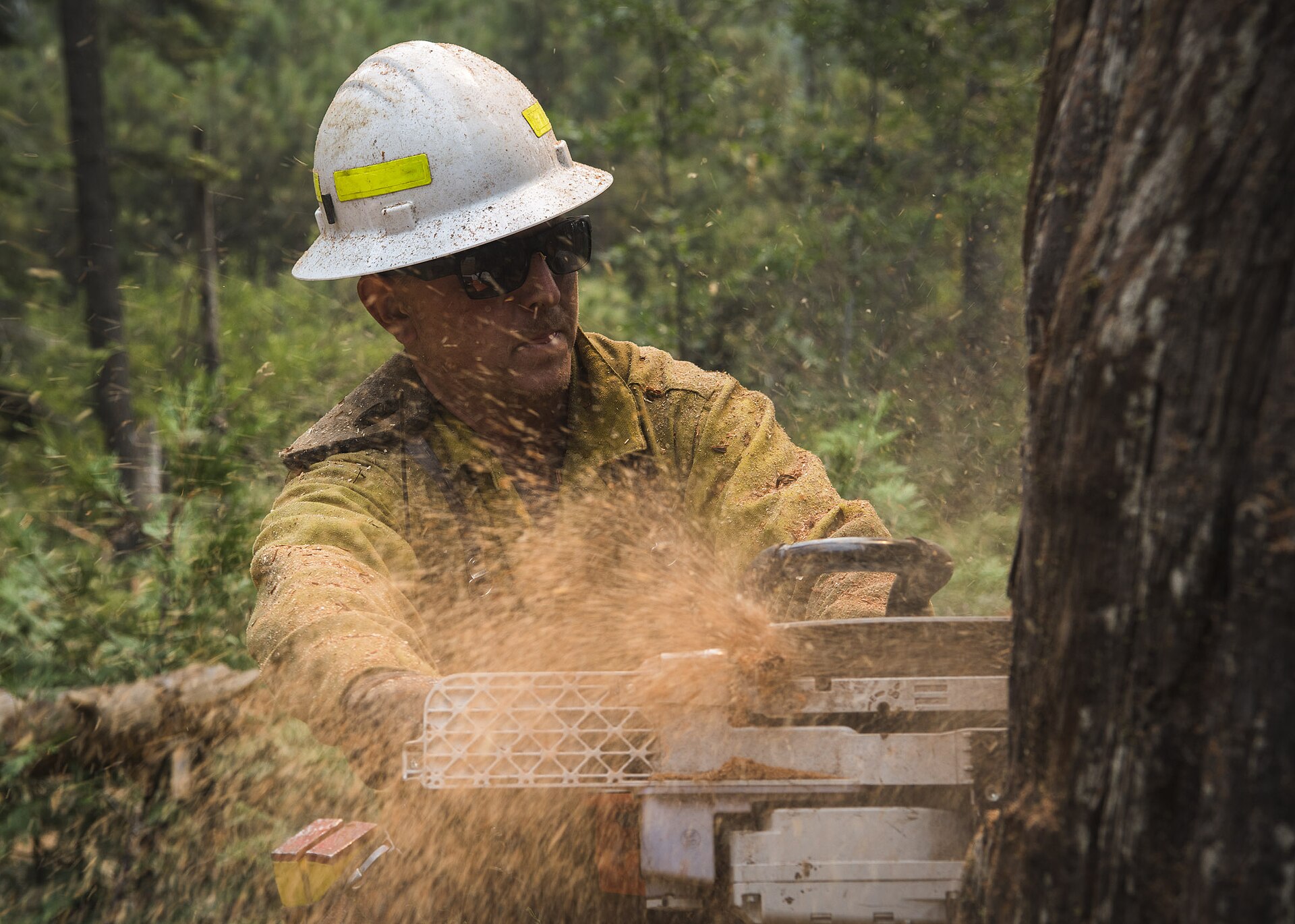
OSHA opens its logging page with a sentence that needs no dressing up: "By many measures, logging is the most dangerous occupation in the United States." That sentence is about professionals - people who fell trees every working day, with employer-provided equipment, under a federal standard written specifically for them. A landowner dropping one leaning oak behind the barn faces the same physics with none of that around him.
OSHA's felling eTool narrows the statistic to this page's subject and refuses to be fatalistic about it in the same breath: "More people are killed while felling trees than during any other logging activity. These accidents CAN be avoided!" - capitals in the original. Felling itself gets a definition worth keeping: to cut the tree "in such a way that it falls in the desired direction and results in the least damage to the tree." Direction and control, in other words, are not style points - they are the entire difference between a fell and an accident.
The agency's hazard framing explains why. The work pairs chain saws with what OSHA calls the "massive weights and irresistible momentum of falling, rolling, and sliding trees and logs," and conditions sharpen everything: uneven, unstable, or rough terrain; rain, snow, lightning, and wind; extreme cold; and remote sites where a hospital is not close when something goes wrong.
This page reports, in plain language, what the federal logging standard - 29 CFR 1910.266 - and university extension publications say about doing this work. Every claim traces to one of the sources listed at the bottom, and where a fact could not be read in a published source, the page says less instead of guessing. It is a briefing, not a course; the training section at the end is the part that actually puts hands on a saw.
Before the first cut
Read the tree before starting the saw
Reported from MSU Extension P2250 · OSHA 29 CFR 1910.266
Mississippi State University Extension's felling publication, P2250, starts before the saw does. Its step one is assessment: where is the tree, which way does it lean, can it actually be put where you want it, and where are the escape routes out of the area. None of those questions involve a running engine.
Lean is measured, not eyeballed. The MSU method is an axe held out at arm's length as a plumb line, compared against the trunk from multiple points around the tree - a tree that looks straight from one side often is not from another. Weather gets a vote too: MSU notes that wind can push a tree in unexpected directions, and that rain can make conditions too slippery to cut safely at all.
The federal standard adds its own pre-cut checks. Under 1910.266, each tree is checked for accumulations of snow and ice before felling; trees are not felled in a way that could strike ropes, cables, power lines, or machines; and when conditions are unfamiliar or unusually hazardous, the immediate supervisor is consulted before cutting begins. The standard also keeps occupied work areas at least two tree lengths apart - more on slopes, where a felled tree can roll or slide.
The face cut, the back cut, the hinge
Two cuts and the wood between them
Reported from MSU Extension P2250 · OSHA 29 CFR 1910.266 · UGA Extension C1220
Every controlled fell in both sources comes down to two cuts and the strip of wood between them. The first is the face cut - what the standard calls the undercut and defines as "a notch cut in a tree to guide the direction of the tree fall and to prevent splitting or kickback." MSU P2250 describes it as a wedge, typically 45 to 90 degrees, removed from the side of the tree facing the direction of fall, and recommends a 60-to-70-degree face cut with a flat bottom as the basic form.
The second is the back cut, made on the opposite side, even with or one to two inches above the base of the notch and parallel to it. The cut never goes all the way through: MSU's instruction is to leave one-half to one inch of wood between the back cut and the notch. That strip is the hinge, and it controls the direction and the rate of the fall the way a door hinge controls a door.
The federal standard says the same thing in regulatory language: every felled tree gets a backcut; the backcut leaves "sufficient hinge wood" to hold the tree to the stump through most of its fall and guide it where it was aimed; and the backcut sits above the level of the horizontal facecut "to provide an adequate platform to prevent kickback" - the tree kicking back over the stump, in this case, not the saw. The one exception the standard allows is for trees being pulled over with rigging.
University of Georgia Extension's Circular 1220 teaches a newer geometry on the same anatomy: an open-faced notch of 70 to 90 degrees, which it calls safer than the traditional 45-degree notch because the wide faces do not close before the tree is on the ground - the hinge keeps steering the whole way down. Paired with the open face is the bore cut, sometimes called a plunge cut: instead of sawing in from the back and racing the lean, the bar is bored through the tree behind the notch, so the hinge is set to its final thickness before the tree can move - 10 percent of the wood remaining behind the notch on trees up to 24 inches in diameter, 5 percent on larger trees. The tree stays held by a strap of wood at the back, which is cut last. C1220's own caution comes with the technique: practice the bore cut on downed logs before ever using it on a standing tree.
The tool that is not the saw
Wedges: required equipment, not an accessory
Reported from UGA Extension C1220 · Clemson Extension · OSHA logging eTool: wedges
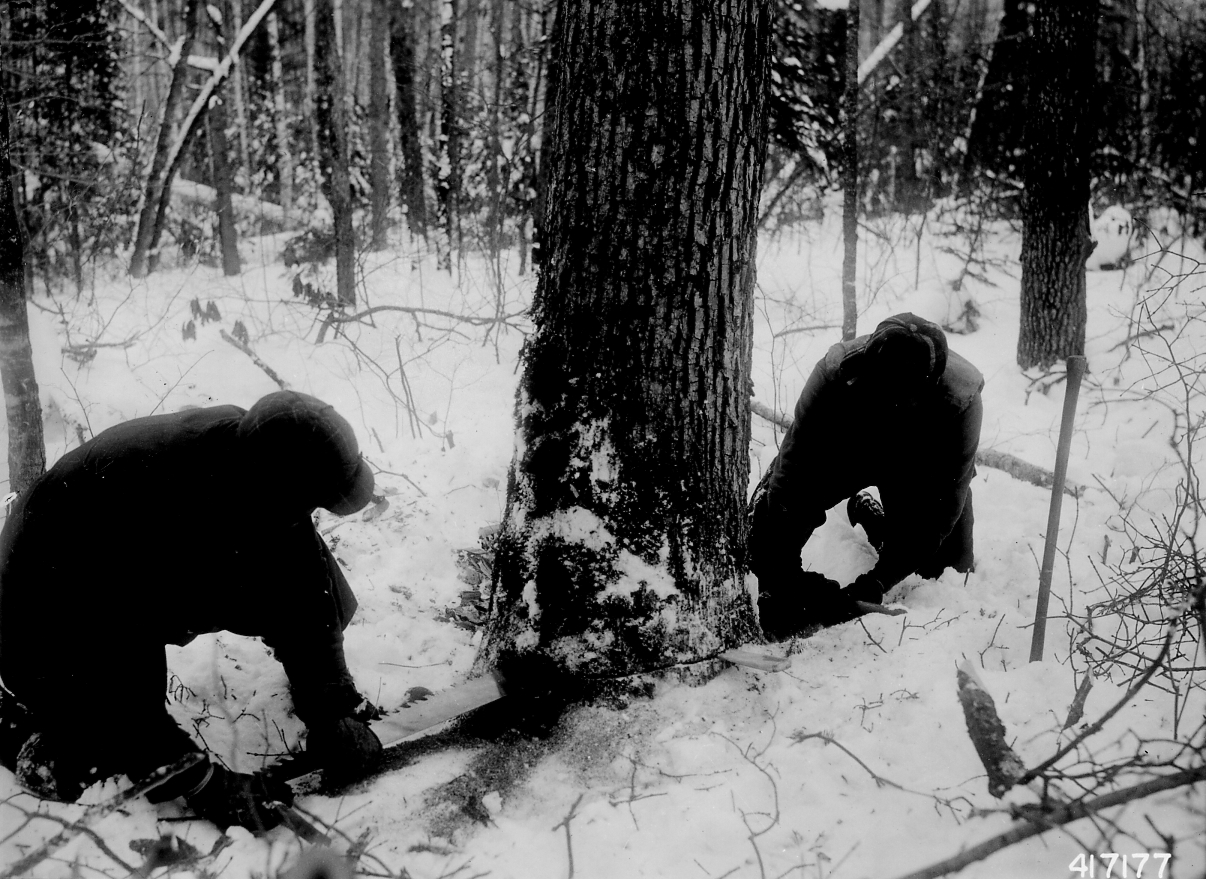
UGA Circular 1220 does not treat the felling wedge as optional gear: "Wedges are required on-site equipment any time a tree is felled. Always place a wedge in the back cut, regardless of the direction of lean." Clemson Extension's forestry agent puts the stakes the same way - the wedge "might be the difference between success and a terrible accident" - and extends the job description to bucking a downed tree, where a wedge keeps the kerf open so the log cannot pinch shut and trap the bar.
The modern felling wedge is high-impact plastic, and Clemson explains why steel left the woods: striking metal on metal can send fragments flying, while plastic deforms - and a chain that finds a plastic wedge cuts into it instead of shattering against it. A splitting wedge is never a felling wedge. Most fellers, per Clemson, carry a 5.5-inch, an 8-inch, and a 10- or 12-inch wedge, most with a one-inch heel; the 5.5 and the 8 cover most trees under 20 inches in diameter. Length and heel height set the mechanical advantage, and "as the wedge is driven in, it lifts one side of the hinge and helps guide the tree to fall in the desired direction." Stacking two wedges for extra lift is dangerous - they can slip or be forced out - so Clemson's answer is a single taller-heeled wedge, with a barbed pair only when stacking cannot be avoided.
How far a wedge can move a back-leaning tree is arithmetic, and OSHA's logging eTool publishes it as the segment method: picture the tree as a stack of squares whose side equals the stump's front-of-hinge-to-back-of-tree dimension. Lifting the bottom of a segment one inch moves the top of that same segment one inch over - so a 70-segment tree moves 70 inches at the top for one inch of lift at the stump. Tall, narrow trees have more segments and wedge farther: the eTool's 70-foot examples run from about 63 inches of back lean handled at 10 inches of diameter down to about 20 inches at 20. The rule of thumb is height divided by diameter - minus something, because the wedge spends the first part of its travel just filling the saw kerf before it lifts anything.
When the lean is the hazard
Heavy leaners and the barber chair
Reported from OSHA logging eTool: difficult trees · UGA Extension C1243
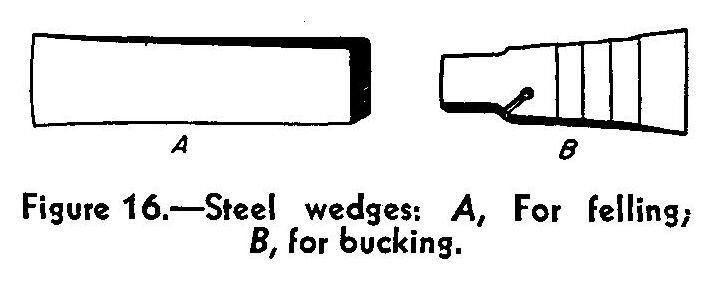
Lean cuts both ways. OSHA's eTool allows that a large tree can be felled against its natural lean - one or more wedges set in the back cut and driven with an axe as the cut is sawn - with how much back lean can be overcome decided by the segment arithmetic above. UGA Circular 1243 names what the wedge is insuring against: setback, the back-leaning tree sitting down on the bar mid-cut and, in the extreme case, falling backward onto the feller.
A heavy forward lean is the more violent problem, and its signature accident has a name. In a barber chair, per C1243, the force pulling forward on the trunk "is great enough to split the trunk but not great enough to trigger the hinge to fold" - the trunk splits vertically up its length, and "the bottom of the tree goes up and the top comes down - like a barber's chair, feet up, head down." The operator is struck by the swinging trunk or crushed under it.
Both sources converge on the same countermeasure: do not saw slowly in from the back of a splitting-prone leaner. OSHA's technique for heavy leaners is a shallow notch of a quarter to a third of the diameter, then boring out the center from behind the notch with the bar held horizontally, leaving a good hinge and a strap of holding wood at the back - the strap is severed last, and the tree goes over guided by the hinge. C1243's version is the open-faced notch followed by the bore cut, which it says puts less force on the trunk's longitudinal fibers and - just as important - takes the operator out from behind the tree while it is under tension.
C1243 also names the failure at the other end of the notch: the stump jump, where the hinge fails entirely and the tree detaches - in free fall and out of control. Its preventives are the same pair, open-faced notch and bore cut, plus two do-nots: no deep notch of less than 45 degrees, and no back cut made too high. OSHA's eTool closes the topic by naming techniques it calls unacceptable outright, among them domino felling - notching a series of trees and pushing them over with another tree - and the "swing Dutchman."
Getting away
The retreat path is cleared before the cut, not after
Reported from OSHA 29 CFR 1910.266 · MSU Extension P2250 · UGA Extension C1220
1910.266 puts the escape before the cut: a retreat path is planned and cleared before felling begins, and it runs diagonally away from the expected felling line. Once the backcut is made, the standard has the feller move a safe distance down that path immediately - the moment of the fall is spent leaving, not watching.
MSU's version covers the seconds in between. Once the tree begins to fall: remove the saw from the cut, turn it off, and proceed quickly - do not run - along the escape path, away from the direction of fall. The standard agrees on the saw: it is shut off or the throttle released before the feller starts the retreat, so nobody is moving through brush behind a chain that is still turning.
UGA Circular 1220 attaches the numbers that explain the urgency, in what it calls the 90-15-5 rule: "Ninety percent of tree felling accidents happen within 15 seconds of the tree beginning to move, and within 5 ft of the trunk." Its escape route runs at a 45-degree angle away from the intended direction of fall and is cleared of tripping hazards before any cutting starts - and its last instruction covers the walk itself: do not turn your back on a moving tree.
The saw fights back
Kickback, and the rules written against it
Reported from MSU Extension P2250 · OSHA 29 CFR 1910.266 · UGA Extension C1243
Kickback is the chainsaw accident that happens faster than a reaction. MSU P2250 describes the mechanics: the tip of the bar contacts something while the chain is moving, a single sawtooth jams into the object, and the energy of the saw is redirected back and up, making the saw jump in the operator's hands. The publication is plain that it can cause severe injury.
UGA Circular 1243 maps exactly where on the saw it happens: the top quarter of the bar tip, which it calls the kickback zone. When wood meets the chain there, the cutter's depth gauge sits lower than it should relative to the tooth, the saw "bites off more than it can chew," the chain slows or stops, and the force that was driving it flings the bar back at the operator. The same circular's pre-start inspection covers five essential safety features - chain brake, throttle lock, right hand guard, chain catcher, and spark arrestor - and its rule for a saw missing any one of them is blunt: do not use it; tag it out and take the bar off so nobody else does either.
Hardware helps but is the backup, not the plan. MSU notes that most new chainsaws carry an inertial chain brake that engages automatically when the saw is thrown back at a certain speed. The operating rules in 1910.266 are the plan: the operator is certain of footing before cutting; the saw is not used from an off-balance position or with an insecure grip; both hands stay on the saw while it cuts; brush is cleared before felling; and the saw is never used to cut directly overhead.
The standard's carrying rule closes out the time between cuts: the saw is carried so the operator cannot contact the moving chain or the muffler. MSU renders the same idea concretely - engine stopped, bar and chain to the rear, muffler away from the body.
The trees that break the pattern
Snags, lodged trees, and spring poles
Reported from OSHA 29 CFR 1910.266
The standard reserves its bluntest language for trees that are already broken. A danger tree - defined as a standing tree hazardous because of deterioration or damage to its roots, trunk, stem, or limbs, or because of its lean - "shall be felled, removed or avoided." Danger trees, including lodged trees and snags (a snag is any standing dead tree or portion of one), are felled or removed using techniques that minimize the feller's exposure; where that cannot be done, they are marked and no work happens within two tree lengths of them.
A lodged tree - the standard also calls it a hung tree - is one that started to fall and is leaning against another tree or object that keeps it from coming down. It did not finish falling; something is holding it up, and the standard classifies it as a danger tree, not a completed fell.
Spring poles get their own rule. A spring pole is a tree, limb, or sapling bent under the weight of another object - stored energy held by wood fiber. When one is cut and the stress releases, 1910.266 keeps every employee other than the feller at least two tree lengths away.
What stands between the chain and the leg
The gear the standard makes employers buy
Reported from OSHA 29 CFR 1910.266 · MSU Extension P2250
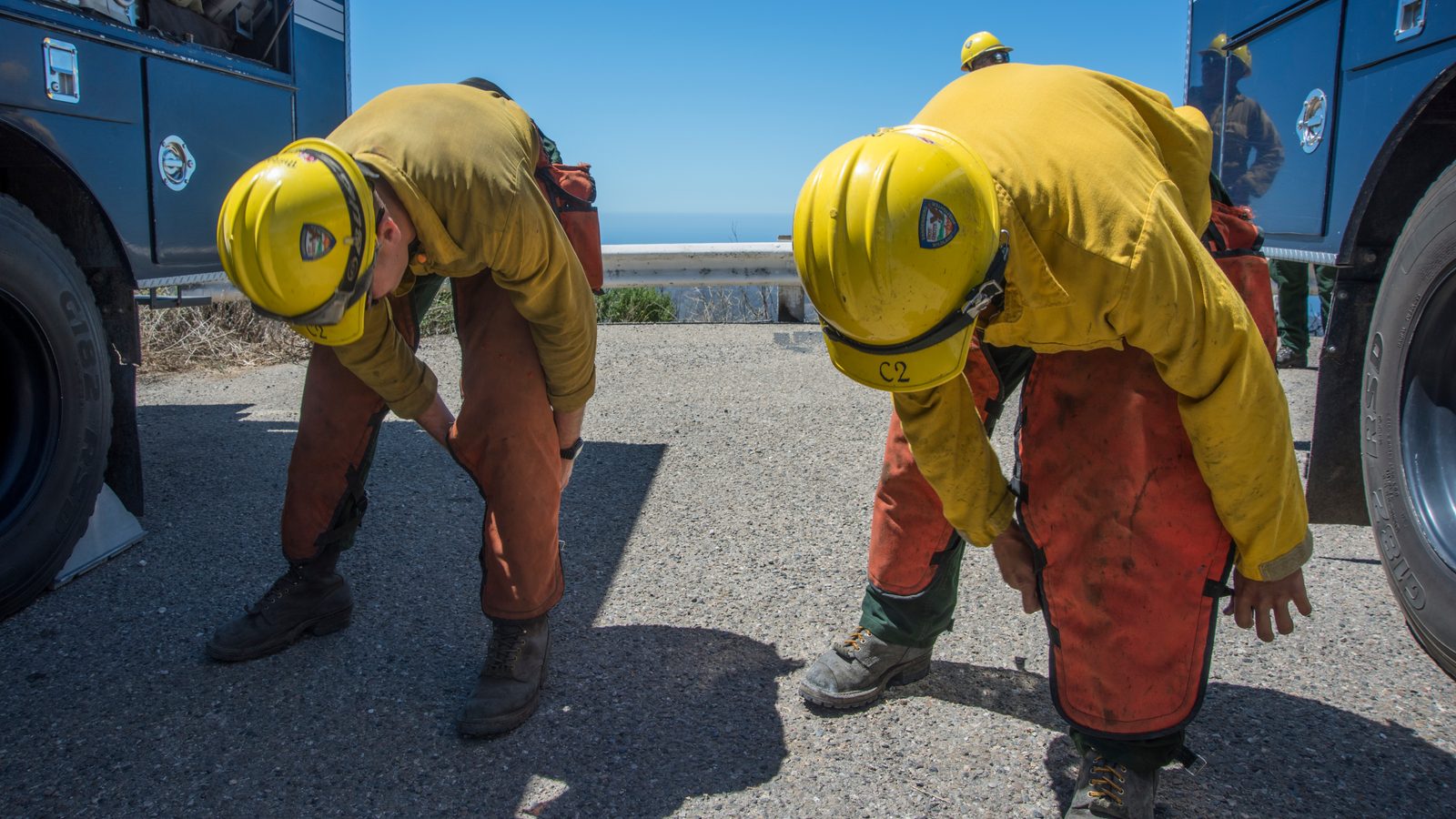
For a logging employer, PPE is not a suggestion or a cost to split. 1910.266 requires the employer to provide it at no cost to the employee: leg protection of cut-resistant material such as ballistic nylon, covering the full length of the thigh to the top of the boot, for every chain saw operator; heavy-duty logging boots that are waterproof or water-repellent, cover and support the ankle, and are cut-resistant for saw operators; head protection wherever falling or flying objects are a possibility; and eye protection, with face protection where facial injury is possible - logger-style mesh screens are permitted.
MSU P2250 turns the same list into part numbers a landowner can take to a store: cutting chaps meeting ASTM F1414-19; steel-toed boots, with ASTM F1458-04 as the test standard against cutting and crushing; and a hard hat meeting ANSI Z89.1, which the publication calls "the most overlooked piece of in-woods safety equipment." Its recommended configuration is a hard hat with earmuffs and a face shield - "best for all saw work" - plus gloves.
The hazard that makes no sound
"Fatigue is your enemy"
Reported from MSU Extension P2250
MSU P2250 gives tiredness three of the most direct sentences in the whole publication: "Do not operate the saw when you are tired. Fatigue is your enemy. Rest helps you stay alert with a strong sense of balance, footing, and saw grip."
Read that list against everything above it. Balance and footing are what the standard's operating rules assume before any cut is made. Grip is what keeps kickback survivable. Alertness is what notices the lean that changed, the limb that hung up, the spring pole under the brush. Fatigue does not add a new hazard to the woods - it quietly withdraws the faculties every other rule on this page depends on, and it does it without announcing itself the way a snag or a storm does.
The same MSU material draws the wider impairment line: no saw work after alcohol, and none while on prescription or nonprescription drugs. It also names the two positions a tired sawyer drifts into - overreaching, and cutting above shoulder height - because the saw is difficult to control in awkward positions even with fresh arms. The sourced countermeasure is not complicated: rest, and a saw that stays off while you are tired.
The saw itself
Maintenance, fueling, and the ten-minute rule
Reported from MSU Extension P2250 · UGA Extension C1208
MSU's maintenance posture is deliberately narrow: learn the basic maintenance points, follow the manufacturer's sharpening and maintenance instructions, and leave every other repair to a professional. The owner's guide - not a forum, not a neighbor - is where the correct chain tension, gas mixture, and oil weight for a particular saw live, and P2250 points there instead of publishing one-size numbers. This page follows it: no fuel ratio appears here, because the publication's answer is the manual for your saw.
Fueling has its own choreography, and it is fire-driven. Per MSU: let the saw cool for about ten minutes before refueling - the publication notes the cooling wait is also a good time to sharpen the chain - move the saw at least ten feet from the fueling spot before starting it, and no smoking while fuel is out.
Transport and the space around the work round out the list: a guide bar scabbard for carrying; engine stopped, bar and chain to the rear, muffler away from the body; children and pets kept at a safe distance; and extra caution near fences and loose or scrap wire, which the chain will find before the eye does.
UGA Circular 1208 adds the wear items. A chain is due for sharpening when the saw needs pressure to cut or the chips come off fine and dust-like; the witness lines on each cutter align the file and also mark the chain's end of life - filed down to the witness line, a chain is replaced, not sharpened again. A new chain gets a break-in: run it two to three minutes, then re-check and adjust the tension. The bar has its own short list: file off burrs along the edges, clean out the rails, keep the oil hole at the base clear so bar oil keeps flowing, grease the sprocket nose, and flip the bar over at every sharpening so both sides wear evenly.
Where the reading stops
Read less, train more
Reported from Game of Logging · Alabama Extension · MSU Extension P2250
Everything above is reporting. None of it is muscle memory, and felling is a muscle-memory trade - which is why the last stop on this page is not another paragraph but a list of places that put a saw in your hands with an instructor watching. These are the programs whose pages could be fetched and read when this page was written; each entry links to the program itself.
AXE USA lists these programs the way it lists everything on this site: because they exist and their own pages say what they teach. A listing is not an endorsement, and AXE USA has no relationship with any of them. Pick one the way you would pick any course - call, ask who teaches it, and ask what a session actually covers.
Game of Logging
The Game of Logging (national)
Hands-on chainsaw safety and productivity training - widely acknowledged as the original premier program of its kind, with instructors combining demonstration and participation in a competitive format.
Chainsaw safety series & county courses
Alabama Cooperative Extension System (Auburn University & Alabama A&M)
A published chainsaw-safety series plus recurring hands-on courses across Alabama counties - recent listings ran in Washington, Conecuh, Calhoun, Lee, and Chambers counties and in Brewton.
Chain Saw Safety: Tree Felling (P2250)
Mississippi State University Extension
The written curriculum much of this page reports: assessment, the face and back cuts, kickback, PPE, fatigue, and maintenance - revised by an extension forestry professor.
Where this leads
The safest saw is the one somebody else is paid and insured to run. If this page turned into a job on your own ground, these are the tools that hand it off.
Read this first
This page reports what OSHA's logging standard and university extension publications say about felling trees and running a chainsaw. It is not training, it is not professional advice, and reading it does not prepare anyone to drop a tree. Felling kills experienced professionals every year. If a tree stands near a structure, a power line, a road, or anything else you cannot afford to hit - or if any of this is new to you - hire an insured professional, and take a hands-on course before you run a saw alone.
Have it felled instead
Say what needs to come down and where. Listed professionals covering that work in your state are emailed an introduction - AXE USA lists them, it does not check them, so ask about insurance yourself.
Open itIf it's timber, sell it standing
Enough trees worth felling is a timber sale, and in a timber sale the felling is the buyer's job, done by insured crews. Post the tract once and take sealed bids.
Open itClearing more than a few trees
What clearing, forestry mulching, and site prep involve and roughly cost - with sealed bids from crews working your county at the end of it.
Open itWhere this came from
Everything on this page was read in one of the documents below, all fetched live when the page was written. Where a planned topic's sources could not be fetched - fatality counts, fuel-mix ratios, freeing a hung tree - the topic was cut from the page rather than written from memory. The wedge, bore-cut, and leaner sections were added in a second round, after the UGA, Clemson, and OSHA-eTool pages that carry them were fetched and read.
- Logging operations standard, 29 CFR 1910.266Occupational Safety and Health Administration, U.S. Dept. of Labor
- Safety and Health Topics: LoggingOccupational Safety and Health Administration, U.S. Dept. of Labor
- Chain Saw Safety: Tree Felling (Publication 2250)Mississippi State University Extension Service
- Game of Logging chainsaw safety trainingThe Game of Logging
- Chainsaw safety series and county coursesAlabama Cooperative Extension System (Auburn University & Alabama A&M)
- Logging eTool - Manual Operations: Felling TreesOccupational Safety and Health Administration, U.S. Dept. of Labor
- Logging eTool - Felling Trees: WedgesOccupational Safety and Health Administration, U.S. Dept. of Labor
- Logging eTool - Special Techniques for Felling Difficult TreesOccupational Safety and Health Administration, U.S. Dept. of Labor
- Chainsaw Safety: The Five Step Tree Felling Plan (Circular 1220)University of Georgia Cooperative Extension
- Chainsaw Safety: Preventing Common Tree Felling Accidents (Circular 1243)University of Georgia Cooperative Extension
- Chainsaw Chains and Bars (Circular 1208)University of Georgia Cooperative Extension
- Felling Wedges: As Important As The ChainsawClemson University Cooperative Extension