Castanea dentata
American Chestnut
The tree that fed the mountains, floored the barns, and went from one in four hardwoods to a memory in forty years.
Also called: Sweet chestnut, wormy chestnut (the salvaged wood)
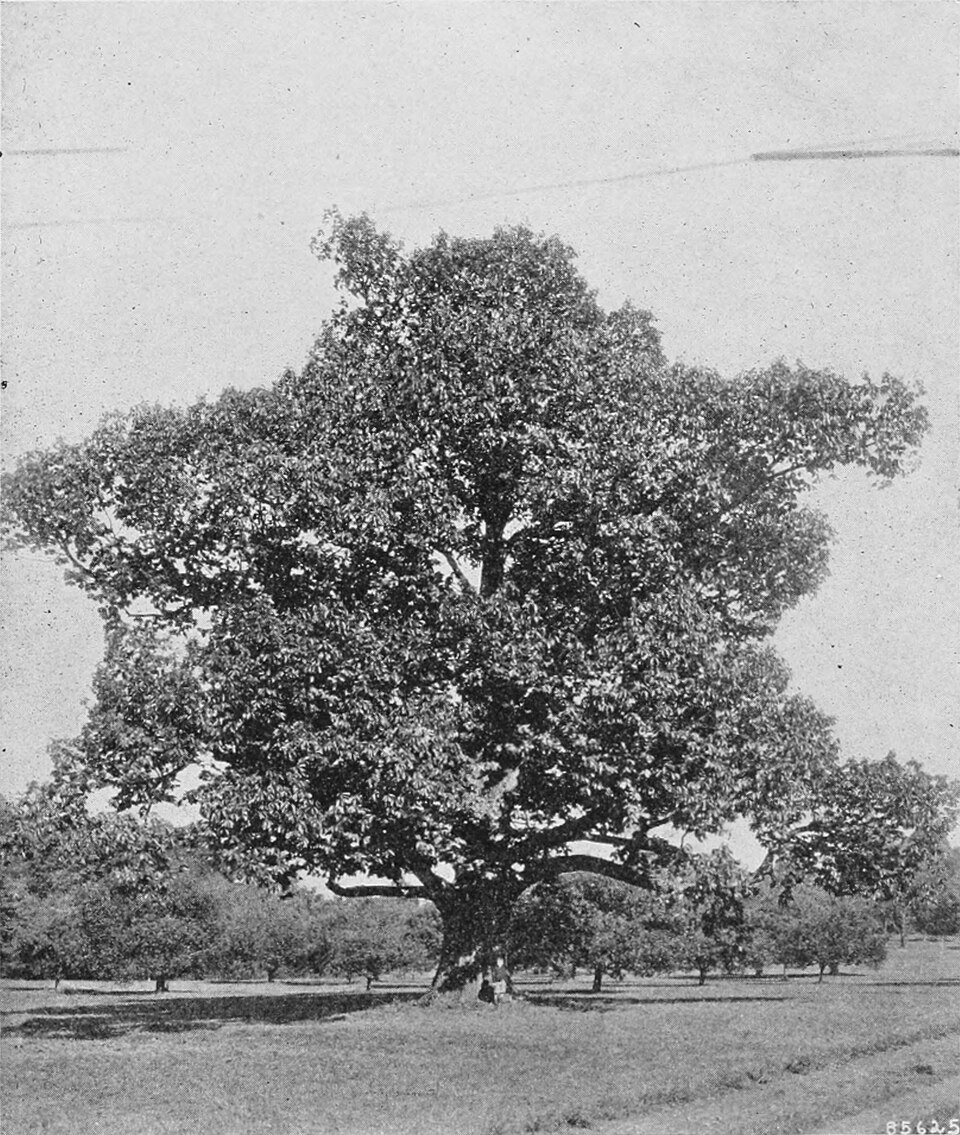
- Native range
- Maine to Mississippi, ~200M acres
- Historic size
- 100 ft tall, 5-8 ft diameter
- Janka hardness
- 540 lbf - soft for a hardwood
- Status today
- Functionally extinct, root systems alive
Old Meaning
The tree that paid the taxes
In the southern Appalachians the chestnut was called the "cradle-to-grave tree," and that was not poetry. The wood was light, straight, and easy for a man with a froe to work, so a family baby slept in a chestnut cradle and the same family buried its dead in a chestnut coffin. In between, the tree floored the cabin, sided the barn, split into the rails that fenced the bottom, and shingled the roof over all of it.
The nuts were the real money. A mature chestnut dropped a heavy crop nearly every year - unlike oak, which masts hard some years and not at all in others - and it dropped it late, after the first frost, when everything in the woods was trying to put on winter weight. Hogs and cattle were turned into the timber in the fall and came out fat without a bushel of bought feed. What the stock did not get, families picked up by hand and hauled to the railhead in wagons. Whole mountain counties settled their store accounts and their land taxes on the chestnut crop.
That is the meaning worth carrying: this was not a tree people admired, it was a tree people lived off. The roasted chestnuts in the Christmas song are the last thin trace of an economy - the street vendors in the eastern cities were selling the same crop that was paying a Tennessee farmer's taxes, and both ended at the same time and for the same reason.
There is no folklore of the American chestnut as a sacred or magical tree, and this page is not going to invent any. What there is instead is a folklore of abundance: old accounts describing the ridges in June looking snow-covered from the bloom, and men saying you could walk for a day and never be out from under chestnut. Those accounts read like exaggeration. The survey records say they were not.
Documented History
1904, the Bronx, and forty years
In 1904 Hermann Merkel, chief forester at the New York Zoological Park in the Bronx, reported that the chestnuts on the grounds were dying. The following year William Murrill at the New York Botanical Garden isolated the fungus responsible and described it as a new species. It carries the name Cryphonectria parasitica today. It had arrived on imported Asian chestnut nursery stock - Japanese and Chinese chestnuts had co-evolved with it and shrugged it off, and nobody had reason yet to think a nursery shipment could carry an extinction event.
The fungus enters through a wound in the bark, spreads under it, and girdles the stem. Everything above the girdle dies. Spores move on wind, rain splash, birds, and insects, and the front advanced roughly 20 to 50 miles a year down the Appalachians. By the mid-1920s it was through Virginia. By the 1940s it had run the length of the range. The commonly cited figure is three to four billion trees - the dominant hardwood of the eastern forest, gone inside a single working lifetime.
The salvage that followed was the largest in American history, and it is why so much chestnut is still in the buildings of the South. Crews cut the standing dead for twenty and thirty years after it died, because the heartwood does not rot standing up. The insects that moved into those dead trunks left the tracks that give reclaimed chestnut the name it sells under now: wormy chestnut.
The species is not extinct. The fungus kills the stem but not the root collar, so old root systems still push up sprouts across the entire historic range - and then get girdled again before the sprout is big enough to flower. The tree persists as a shrub that never gets to reproduce. Foresters call this functionally extinct, which is the precise term and also the bleakest one.
Restoration has been worked at seriously since the 1980s. The American Chestnut Foundation has run a backcross breeding program crossing American chestnut with blight-resistant Chinese chestnut and breeding back toward the American form. A separate transgenic line developed at SUNY-ESF, carrying a wheat oxalate oxidase gene and known as Darling 58, was for years the most publicized path forward and was under federal petition for deregulation.
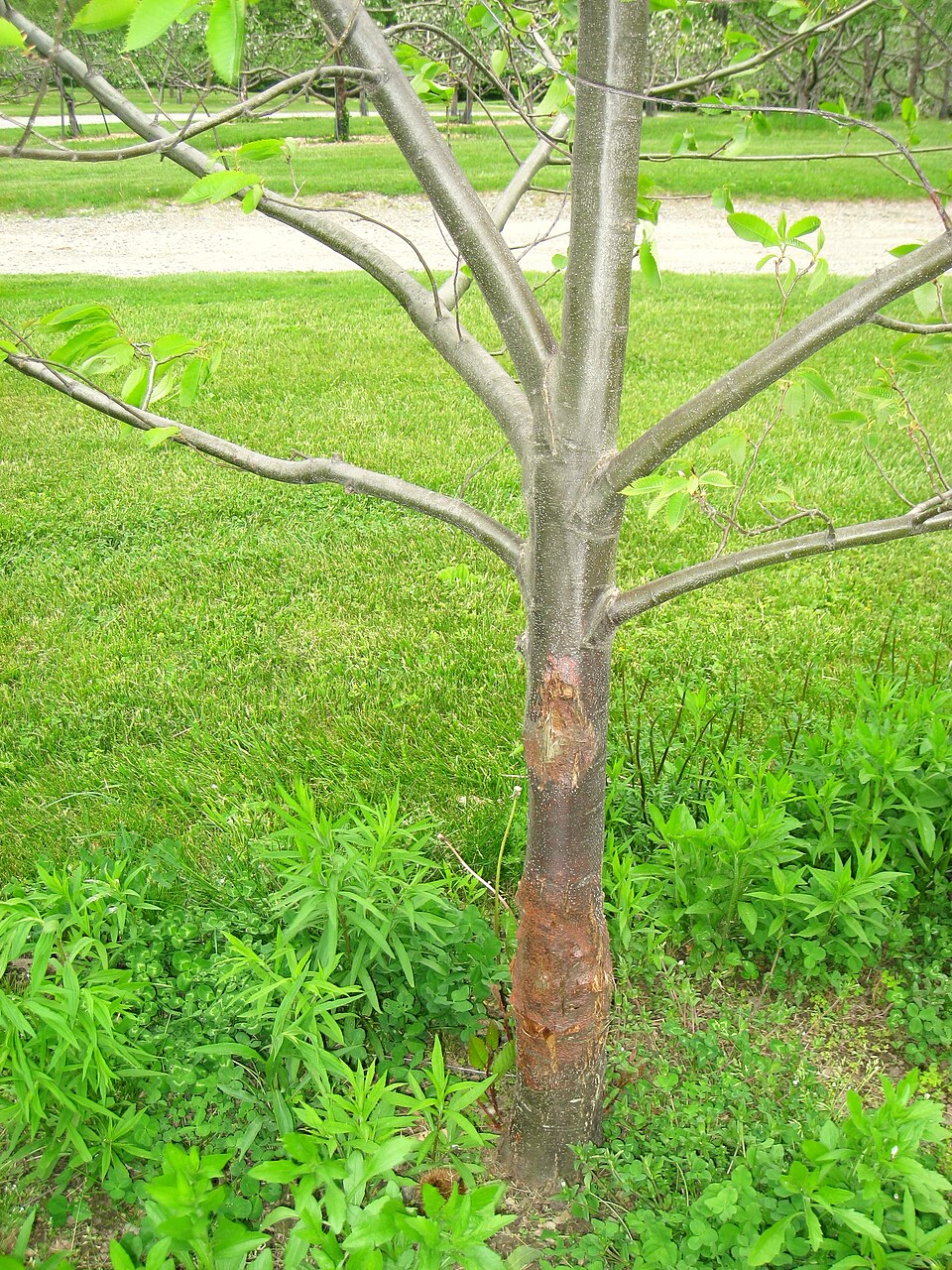
A blight canker. The fungus spreads beneath the bark and girdles the stem; everything above it dies, while the root collar survives to sprout again.
Public domain.
Medicinal Record
A cough remedy and a great deal of tannin
Read this first
What follows is a record of what people used and what published sources documented - nothing more. It is not medical advice, it is not a recommendation, and no plant on this page is a treatment for anything. Several of these trees are toxic to livestock and some are toxic to people. Do not eat, brew, or dose anything based on a history page. Talk to a physician, and talk to a veterinarian before your animals get near any of it.
The chestnut's place in the American medical record is narrow and specific: the leaves. Chestnut leaf was carried in nineteenth-century American pharmacy and eclectic-medicine texts as an astringent, prescribed chiefly for whooping cough, and it stayed in the pharmacopoeial listings long enough that a great many rural households knew the preparation without knowing the book. It fell out of use as the tree fell out of the woods, and it has no place in modern medicine.
The active principle behind the astringency was tannin, and that is the thread connecting the sickroom to the biggest industrial use the tree ever had. American chestnut wood and bark were extraordinarily rich in tannin, and the leather industry ran on it. Extract plants across Appalachia chipped chestnut - much of it standing dead from the blight - and boiled the tannin out of it for tanneries. Those plants were the economic reason the salvage cut went on as long as it did, and the reason it finally stopped when the supply ran out in the 1940s and 1950s.
The nuts were food, not medicine, and they are the one part of this record with no cautions attached: sweet, low in oil compared with European chestnut, eaten raw, roasted, boiled, and ground into meal. That is worth stating plainly because the tree that most often gets confused with it - horse chestnut, Aesculus, no relation whatsoever - is toxic. If a source tells you chestnut seed extract does something for your circulation, it is talking about horse chestnut and it is not talking about this tree.
Timber & Owner Value
You will not be selling standing chestnut
The wood was the reason the tree was cut even before the blight gave anyone a reason to hurry. Chestnut is light, straight-grained, ring-porous, and soft for a hardwood at 540 lbf on the Janka scale - softer than red oak by a wide margin and easy to saw, nail, and split. What made it valuable is what it did outdoors: the heartwood is highly decay resistant, so posts, rails, sills, siding, and shingles cut from it lasted decades of weather without a drop of preservative - black locust is the wood that took over that job in the fencerows afterward. Add telegraph poles, mine props, caskets, and musical instrument bodies and you have most of the market it served.
The commercial reality for a landowner in 2026 is short: there is no standing chestnut timber to sell. What there may be is the second market, and it is real money. Reclaimed wormy chestnut - beams out of a barn being taken down, flooring, siding, the insect-tracked salvage boards - trades at premium reclaimed-lumber prices, and a Southern barn built between 1900 and 1940 has a fair chance of having chestnut in it. Before that barn gets pushed into a burn pile, it is worth having somebody who knows the wood look at what is in the frame.
The other thing that may be on your ground is sprouts. Chestnut sprouts off old root collars all through the historic range, and they matter to the people doing restoration work - The American Chestnut Foundation maintains a locator for surviving trees and asks landowners to report them, and a cutover that needs a planting plan and somebody to do the work is the moment to decide what goes back in beside them. It costs you nothing, and a flowering survivor is genuinely rare and genuinely useful to the breeding program.
The last piece of owner value here is not wood at all, it is the lesson. The chestnut economy collapsed because an entire region's income was tied to one species with no substitute in place. Any landowner running a single-species stand today - loblolly wall to wall, one buyer, one product - is holding the same shape of risk, and making buyers bid against each other is the cheapest hedge against the one-buyer half of it. That is a management argument, not a scare story, and it is the most useful thing this tree still has to say.
The wood, by the numbers
- Janka hardness
- 540 lbf
- Specific gravity (12% MC)
- 0.43
- Heartwood decay resistance
- Highly resistant
- Workability
- Easy - saws, nails, and splits cleanly
- Historic uses
- Posts, rails, siding, poles, caskets, tannin
- Market today
- Reclaimed only; no standing commercial timber
Where this leads
History is worth knowing on its own. If it turned into a question about the timber on your own ground, these are the tools that answer it.
Put the timber you do have out to bid
Chestnut is not what is standing on your tract, but oak, poplar, and pine are. Post the tract once and buyers bid sealed against a deadline you set, so nobody bids against a number they can see. Free to post.
Open itFind a consulting forester or a mill
Businesses across the industry, listed by what they do and where they work - foresters, mills, and buyers included. These are self-listed businesses. AXE USA does not vouch for anybody on it; call them and judge for yourself.
Open itPlan what goes back in the ground
Seedling nurseries, planting crews, and site-prep contractors by species, state, and planting window - and the sealed-quote board for replant work. The mixed-species argument this page makes has to be made at planting, not at harvest.
Open itWhere this came from
AXE USA publishes no research of its own. Everything on these pages is read out of USDA Forest Service, USDA NRCS, land-grant extension, and published historical sources, each linked at the bottom of the page so you can go read the original.
- Silvics of North America, Vol. 2: Castanea dentataUSDA Forest Service
- Chestnut Blight - Plant Disease LessonsAmerican Phytopathological Society
- Restoration science, breeding program, and the Darling 58 statementThe American Chestnut Foundation
- Wood Handbook: Wood as an Engineering Material (FPL-GTR-282)USDA Forest Products Laboratory