Robinia pseudoacacia (and the true acacias, Vachellia spp.)
Acacia & Black Locust
Two different trees, one shared name, and a hundred years of people arguing past each other. One of them is the hardest rot-proof post wood in North America.
Also called: Black locust, yellow locust, "acacia" on most Southern log decks
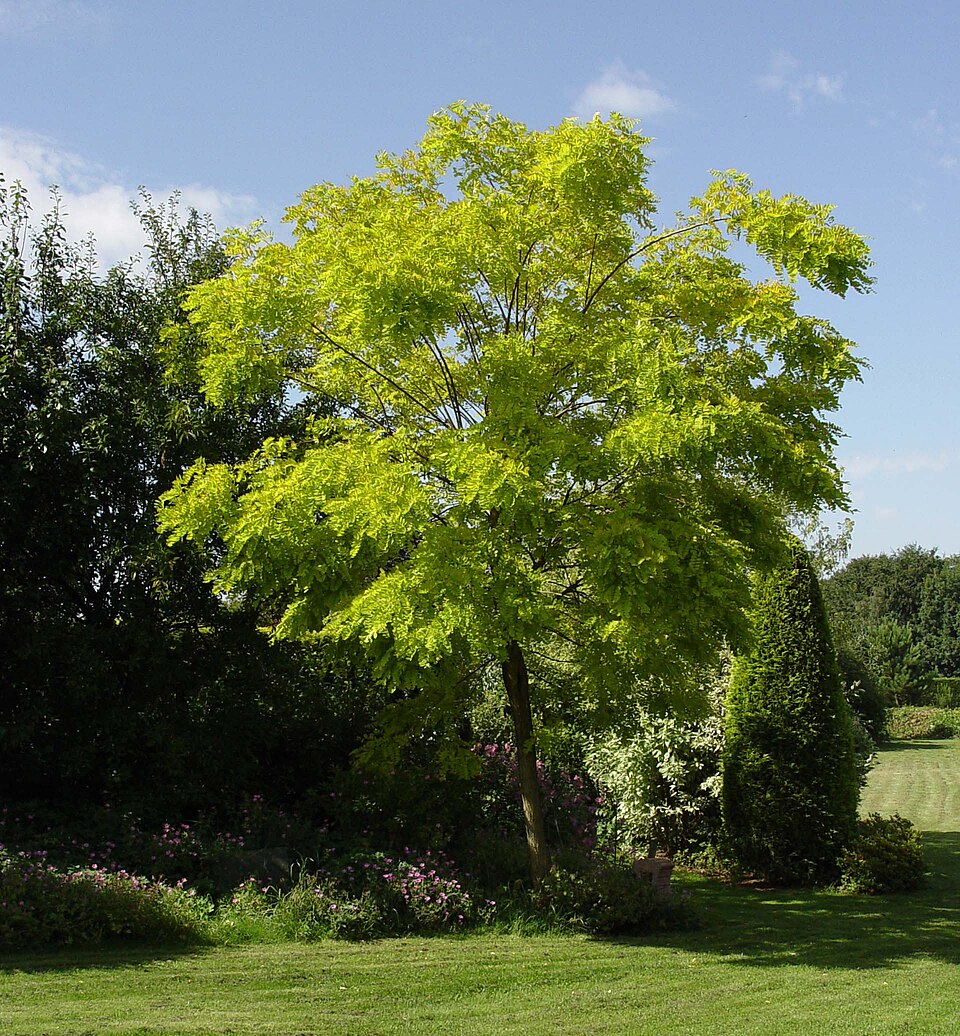
- Native range
- Appalachians and the Ozark plateau
- Typical size
- 40-80 ft, 2-4 ft diameter, often crooked
- Janka hardness
- 1,700 lbf - above white oak
- Untreated post life
- Commonly 30+ years in the ground
Old Meaning
Two trees, one word, and the confusion that follows
Start here, because nearly every argument about this tree is really an argument about the name. There are two entirely unrelated trees being called acacia, they grow on different continents, and they belong to different genera.
The first is the true acacia of the Sinai and the Negev - thorn trees now placed in the genus Vachellia, principally Vachellia tortilis, V. seyal, and V. raddiana. This is the shittim wood of Exodus. The Ark of the Covenant is specified down to the board: acacia overlaid with gold inside and out, with acacia carrying poles that were never to be removed from its rings. The same wood makes the boards of the tabernacle, its bars and pillars, the altar and the table. There is a plain reason behind the specification. Acacia was the only durable timber of any size growing in that desert, and it is dense, dark, and stubbornly resistant to insects and rot - the right wood for a structure that had to be carried, pitched, and struck again across forty years of moving.
Cedar enters the story later, and it marks the change from a tent to a building. When the tabernacle gave way to Solomon's Temple, the wood changed with it: cedar of Lebanon, Cedrus libani, floated down the coast in rafts from Tyre under a timber contract with King Hiram that the book of Kings records in detail, paid in wheat and oil, year after year. The temple was lined with cedar from floor to ceiling - so completely that no stone was left in sight - and the reason is the same reason acacia went into the Ark. Cedar of Lebanon is aromatic, dimensionally stable, and resists decay and insects on its own. It was also enormous, straight, and available in lengths no local tree could match, which is what a permanent building needs and a portable tent does not. Acacia is the wood of a people on the move; cedar is the wood of a people who have stopped.
Worth knowing if you are cutting cedar in the South: yours is not that tree either. Eastern redcedar, Juniperus virginiana, is a juniper. Western redcedar is a cypress relative. Neither is a true cedar, and no Cedrus grows wild in North America. The name carried over for the same reason acacia did - the settlers who named these trees were naming them for a familiar aromatic rot-proof wood, not filing a botanical claim. Your redcedar earns its keep in fence posts and closet lining on its own merits, which is the honest version of the compliment.
The second is black locust, Robinia pseudoacacia, a North American legume native to the central Appalachians and the Ozarks. Linnaeus named the genus for Jean Robin, herbalist to the French kings, who had the tree growing in Paris around 1601 - one of the first North American trees in European cultivation. The species name pseudoacacia means, literally, false acacia: even the botanist naming it was noting the resemblance and denying the identity. Loggers, sawyers, and farmers across the South have called it acacia ever since, and that is a perfectly good local name as long as everyone knows what is being talked about.
So: the wood in the Ark was not black locust, the beams of the Temple were not Southern redcedar, and the post in your fence line is not the acacia of Exodus. Robinia inherited a borrowed name and a borrowed reputation - it is a hardworking American hedge and post tree that happens to deserve a reputation of its own, on the merits. Those merits are the rest of this page.
Documented History
Trunnels, gullies, and a tree that outran its own range
Black locust's native range is two separate blocks - the central Appalachians from Pennsylvania south into Alabama and Georgia, and a second population on the Ozark plateau. It is now naturalized across all of the lower 48 and through much of Europe and Asia, which makes it one of the most widely planted North American trees on earth and, in a fair number of places, a listed invasive. The specimen Jean Robin's family planted at the Jardin des Plantes is still standing and is claimed as the oldest tree in Paris.
In shipbuilding it had a use nothing else did as well. A trunnel - treenail, in writing - is a wooden pin driven through ship timbers to fasten them. Black locust made the best ones available in North America: the pin swells when it gets wet and locks the joint tighter than it was driven, it does not rot, and unlike an iron fastening it does not bleed rust into the surrounding oak and eat the timber around itself. American yards used locust trunnels as a matter of course. There is a persistent story that a shortage of locust trunnels put British ships at a disadvantage in the War of 1812 - it is repeated constantly and it is tradition rather than documented supply history, so treat it as the good story it is.
On land the tree earned its reputation in fence lines. The saying across the upland South is that a black locust post will last "a lifetime and a day," and another version has it lasting one year longer than a stone. Both are exaggeration built on a real number: untreated locust heartwood set in the ground routinely goes thirty years and frequently a good deal longer, in soil that would take a treated pine post in fifteen.
The Southern chapter that matters most to a landowner here is the 1930s. The Civilian Conservation Corps and the Soil Conservation Service planted black locust by the millions across gullied, worn-out cotton land through the Southeast, because it is a nitrogen-fixing legume that grows fast on poor ground and binds a bank with aggressive root suckers. Much of the locust standing on Southern farms today traces to that work or to fence rows planted in the same decades. Plantation forestry with the species mostly failed for a separate reason: the locust borer, Megacyllene robiniae, tunnels the stems and makes clear, straight, sawable trunks unreliable - which is why so much of the locust you will find is crooked, riddled, and hard to get a decent log out of.
Medicinal Record
A thin record, and a real poison
Read this first
What follows is a record of what people used and what published sources documented - nothing more. It is not medical advice, it is not a recommendation, and no plant on this page is a treatment for anything. Several of these trees are toxic to livestock and some are toxic to people. Do not eat, brew, or dose anything based on a history page. Talk to a physician, and talk to a veterinarian before your animals get near any of it.
The medicinal record for black locust is short and mostly cautionary. Nineteenth-century eclectic practice used the inner bark as an emetic and a purgative - which is to say it was used because it makes you violently sick, and it makes you violently sick because it is toxic. There is no modern medical use. The flowers are a different matter and have a long food history: locust blossom fritters are a real regional dish, and locust honey - acacia honey on a European jar label, from exactly this tree - is one of the major monofloral honeys of the world.
The toxicity is the part that matters on a working place. The bark, leaves, seeds, and pods contain the toxalbumins robin and robitin along with the glycoside robinin. Toxalbumins are the same class of compound as ricin and abrin: they work by shutting down protein synthesis in the cells they reach, and small quantities do real damage.
Horses are the most sensitive livestock and the most common casualty, because a horse will strip and chew bark out of boredom. Documented signs include colic, depression, weakness, dilated pupils, irregular heartbeat, and posterior paralysis; deaths are recorded in the veterinary literature. Cattle and sheep are affected less often but are not immune. Poisonings usually trace to one of three things: horses reaching a live locust in or over a paddock, animals turned onto ground where locust has been cut and the brush left within reach, or stock chewing locust fence posts and rails.
The practical rules are simple. Keep live black locust out of reach of horses. Do not leave locust trimmings, tops, or brush where stock can get at them after a cutting job. If you are fencing a horse pasture with locust - and people do, because the posts last - use it where a cribbing horse cannot work on it. Sawdust and bark from milling locust are also an irritant to the people handling it; run dust extraction and do not burn the bark in an enclosed space.
Timber & Owner Value
The best post wood in North America, and no market for it
By the numbers this is one of the best hardwoods on the continent. Black locust runs about 1,700 lbf on the Janka scale, which puts it well above white oak at 1,350 and within reach of shagbark hickory. Specific gravity is roughly 0.69. The USDA Forest Products Laboratory rates the heartwood in its most durable class for resistance to decay - the same category as osage orange and black walnut heartwood, better than white oak, far better than anything you can buy pressure-treated at a lumberyard. It is stiff, it is stable once dry, and it takes a finish beautifully in a color range from greenish gold to deep olive-brown.
It also burns hotter than nearly anything else growing here - on the order of 27 to 28 million BTU per cord, right at the top of the North American firewood tables alongside hickory and osage orange. It coals well and burns clean when it is seasoned. The catch is the interlocked, twisted grain, which makes splitting it by hand a genuine chore.
The uses follow the durability: fence posts and rails first, then decking and outdoor furniture where it stands in as a domestic substitute for tropical hardwoods, boat trunnels and marine work, raised garden beds, mine timbers historically, insulator pins on the old lines, and shiitake mushroom logs. As flooring and millwork it is excellent and almost nobody offers it.
Now the market reality, because this is where a landowner gets misled. There is no commodity market for black locust in the South, and the mill directory shows why: agency listings name pine, oak, hickory and walnut among the species plants accept, and locust appears in none of them. A pulp or sawlog buyer taking your mixed hardwood does not want it - it dulls knives, it is hard on a saw, the stems are usually crooked and borer-tracked, and there is no volume behind it in his order file. Putting locust into a mixed-hardwood tally means selling the best rot-resistant wood you own at the lowest price on the ticket.
It sells by the piece, to people who specifically want it. Post buyers, portable sawyers, timber framers, deck builders, mushroom growers, and firewood customers pay real money for locust and pay it directly. If you have a straight hedgerow of it, the money is in cutting posts and selling them yourself, or in getting a portable mill onto the place and selling slabs and decking, not in rolling it into a timber sale. That is more work than a sealed bid on a timber sale and it is worth more per stick.
Two honest cautions to close on. First, outside its native range black locust is aggressive - it suckers hard from roots and stumps, resprouts after cutting, and several states and agencies list it as invasive and discourage planting it. Cutting it without treating the stump generally gets you a thicket instead of a clearing. Second, in its native Appalachian and Ozark range it is a legitimate native species doing legitimate work fixing nitrogen on poor ground, and it should not be treated as a weed there. Where you stand determines which of those is true.
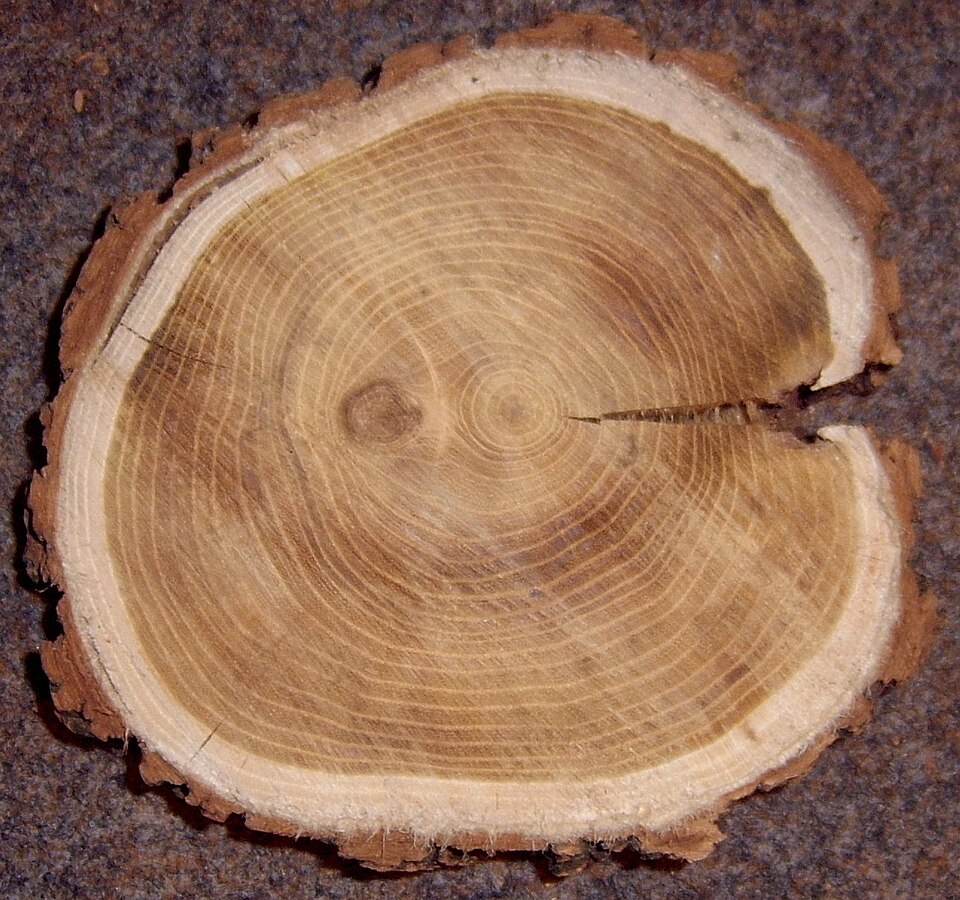
Black locust in cross-section: a thin band of pale sapwood around dense, decay-resistant heartwood. The heartwood is the whole value of the tree.
Public domain.
The wood, by the numbers
- Janka hardness
- 1,700 lbf
- Specific gravity (12% MC)
- 0.69
- Heartwood decay resistance
- Most durable class (FPL)
- Untreated ground contact
- Commonly 30+ years
- Fuel value
- ~27-28 million BTU per cord
- Market today
- No commodity market; sells by the piece
Where this leads
History is worth knowing on its own. If it turned into a question about the timber on your own ground, these are the tools that answer it.
Sell direct instead of by the ton
Locust posts, decking, and slabs are worth more sold to the person who wants them than rolled into a mixed-hardwood load. The marketplace is where owners list to owners - listings carry your own contact details and buyers call you.
Open itFind a portable sawyer or a post buyer
Sawyers, mills, and buyers listed by trade and state. Every business on it listed itself; AXE USA does not verify or approve any of them. It gets you the phone number - the judgment is yours.
Open itBid the rest of the tract, keep the locust out
If you are selling timber, post the tract for sealed bids and write the locust out of the sale as reserved. Bids stay hidden until your deadline passes, and what you exclude is your call to make in the contract.
Open itWhere this came from
AXE USA publishes no research of its own. Everything on these pages is read out of USDA Forest Service, USDA NRCS, land-grant extension, and published historical sources, each linked at the bottom of the page so you can go read the original.
- Silvics of North America, Vol. 2: Robinia pseudoacaciaUSDA Forest Service
- Plant Guide: Black Locust (Robinia pseudoacacia)USDA NRCS National Plant Data Center
- Fire Effects Information System: Robinia pseudoacaciaUSDA Forest Service
- Wood Handbook: Wood as an Engineering Material (FPL-GTR-282)USDA Forest Products Laboratory