Pinus taeda, P. palustris, P. echinata, P. elliottii
Southern Yellow Pine
Ninety million acres of longleaf, an industry that bled it for tar and turpentine, and the plantation pine that writes most Southern timber checks today.
Also called: Loblolly, longleaf, shortleaf, slash - the four species a mill buys and grades together as SYP. Eastern white pine (P. strobus) is a different, softer wood on a different market.
- Native range
- Virginia to east Texas and Florida
- Mature size
- 80-115 ft, 2-3 ft diameter
- Janka hardness
- 690 lbf loblolly, 870 lbf longleaf
- Status today
- The most planted timber type in the U.S.
Old Meaning
Ninety million acres of grass and fire
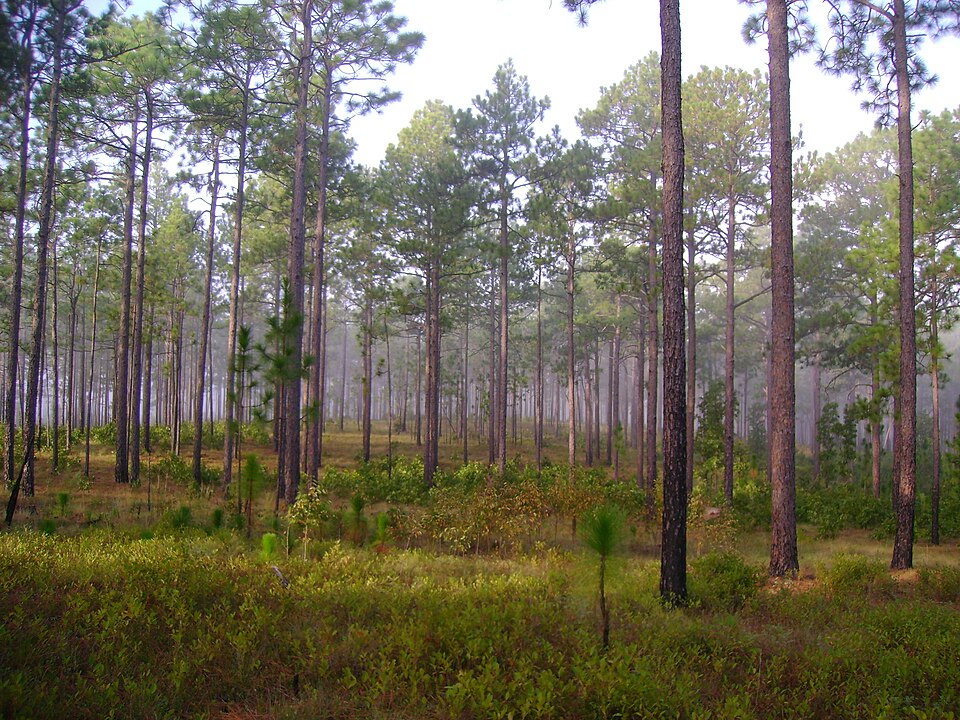
Before anything in the South was planted, the dominant forest of the coastal plain was longleaf pine - southeastern Virginia through the Carolinas and Georgia, across the Gulf states and into east Texas, an original extent commonly given as roughly 90 million acres. That is not a forest the way most people picture one. A mature longleaf stand was open enough to drive a wagon through: heavy trunks spaced wide, almost no middle layer of brush, and a continuous floor of wiregrass, bluestem, legumes, and flowering herbs. The plant diversity in that ground layer is among the highest in North America outside the tropics, and nearly all of it lived on sunlight that reached the dirt between the pines.
Fire held the structure open. Growing-season lightning fires carried through the grass on a return interval usually given as one to five years, killing hardwood seedlings and clearing litter while the pines stood. Longleaf is built for it: the seedling spends its first years in what foresters call the grass stage, a dense tuft of needles a few inches tall over a taproot driving down, terminal bud shielded inside the needles while the tree puts on root instead of height. A tree that spends its childhood pretending to be a clump of grass only makes sense in country that burns.
For the people who lived there, the piney woods were open range first and timber second. Cattle and hogs ran loose in woods a rider could see through, and the herders burned in late winter to bring green grass up out of the ash - a practice documented long before any forestry agency existed, and one that mid-century fire suppression policy spent decades trying to stamp out before Forest Service and extension research put prescribed burning back in the toolbox. The same woods gave heart pine for floors and sills, fat lightwood for kindling, and turpentine wages. This was a working landscape, not a wilderness.
The loss is the part no honest page skips. Depending on how it is measured, something on the order of 3 to 5 percent of the original longleaf range still carries longleaf, and almost none of that is old growth. The direction has changed, and that deserves the same care: since the range-wide effort organized in 2009, the planting, burning, and conversion work tracked by America's Longleaf and The Longleaf Alliance has pushed the total back above five million acres and it is still climbing. Five million against ninety million is not a recovery. It is a floor that stopped falling.
Documented History
Naval stores, the cutover, and what got planted back
The phrase "naval stores" is not a metaphor. A wooden ship needed tar to preserve its standing rigging, pitch to pay its seams, and turpentine and rosin for a dozen jobs besides - stores for a navy, literally. Britain bought them out of the Baltic until it decided it would rather not, and in 1705 Parliament put a bounty on colonial production. Longleaf gum was the raw material, the Carolinas were the first center of it, and North Carolina came out of that century with the nickname Tar Heel still attached.
The work was done to the tree by hand. The old method was boxing: an axe-cut cavity chopped into the base of the trunk to hold the gum as it ran, with a fresh streak chipped into the bark above it every week or so to keep the resin moving. The scar that built up over seasons of chipping is a catface. Boxing hollowed the butt log, invited rot, and left the stem liable to snap in wind or burn through in a fire. Around 1901 to 1903 Charles Holmes Herty, working for the USDA Bureau of Forestry, put forward a clay cup and metal gutter system that took the gum without cutting into the base of the trunk - less destructive, better yielding, and the arrangement most surviving photographs show.
The labor behind it is documented and should not be softened. Before 1865 the naval stores industry of the Carolinas ran substantially on enslaved workers. After emancipation the turpentine belt moved south and west - Georgia, then Florida, then Alabama and Mississippi - and the camps that followed it were isolated, company-owned, paid in commissary scrip against advances, and in places supplied by the convict lease system. Men chipped and dipped by quota for wages that were often debt by the time they were paid. Georgia was the largest producer in the world for stretches of that period.
Gum naval stores ended for market reasons rather than moral ones. Steel hulls needed no pitch, petrochemical solvents undercut spirits of turpentine, and by mid-century most American rosin and turpentine was coming out of kraft pulping as a by-product - crude tall oil and sulfate turpentine recovered at the pulp mill - rather than out of a cup nailed to a tree. Commercial gum operations dwindled through the second half of the twentieth century and effectively ended.
Running ahead of all that was the cutover. Between roughly 1880 and 1930 the virgin longleaf was logged industrially: northern capital moving south once the Lake States were exhausted, logging railroads pushed into the pine, band mills big enough to eat a township. By 1930 the merchantable old-growth longleaf was substantially gone, and what was left sold cheap as cutover land - stumps, slash, no seed trees - to be grazed and burned. Longleaf did not come back on its own, because it cannot: without residual seed trees and the right fire at the right time, the site goes to scrub oak or to whatever pine seeds in first.
What got planted back was loblolly, and slash on the wet flatwoods of the lower coastal plain. Both outgrow longleaf in youth, both plant reliably by machine, and loblolly in particular takes to old cotton ground. Federal and industry programs put them in by the billion of seedlings from the 1930s onward. The result is a paradox worth stating plainly: the modern South grows more pine volume than at any point in the measured record, and almost none of that volume is old longleaf. The forest came back. The forest that was there did not.
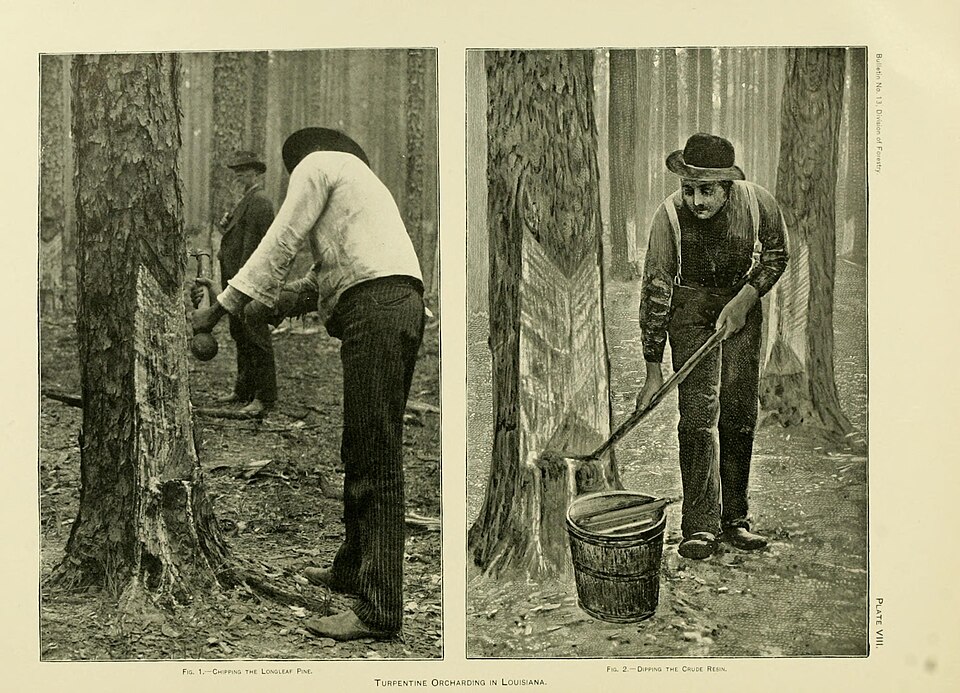
Chipping a catface and dipping the gum, from Charles Mohr's 1896 account of the Southern timber pines. Each weekly streak cut above the last kept the resin running and built the scar the trade named a catface.
Charles Mohr, The Timber Pines of the Southern United States (1896), via the Biodiversity Heritage Library. Public domain.
Medicinal Record
Turpentine, pine tar, and a warning about cattle
Read this first
What follows is a record of what people used and what published sources documented - nothing more. It is not medical advice, it is not a recommendation, and no plant on this page is a treatment for anything. Several of these trees are toxic to livestock and some are toxic to people. Do not eat, brew, or dose anything based on a history page. Talk to a physician, and talk to a veterinarian before your animals get near any of it.
Southern yellow pine has a longer place in the American pharmacy record than most trees on this site, and it is there as an industrial chemical rather than an herb. Spirits of turpentine, distilled from longleaf and slash gum, was an official article of the United States Pharmacopoeia and appears through nineteenth-century practice in two roles: rubbed on the skin in liniments as a counterirritant, and given internally as a vermifuge. The same literature recorded the poisonings - kidney injury, vomiting, delirium - and the internal use fell out of medicine as that came to be understood. Both halves of that record belong on the page.
Pine tar, the thick product of destructively distilling resinous pine wood, was likewise carried in the pharmacopoeia and compounded into ointments and soaps for scaling and itching skin complaints. Pine tar soap is still manufactured and sold, which makes it one of the few preparations in this section a reader might recognize on a shelf. What it was reached for historically is a matter of record. Whether it did what was hoped is not something this page is in a position to say.
Pine needles carry ascorbic acid, and needle infusions recur in the documented record of the colonial and frontier South and in the ethnobotany later compiled for the southern pines - drunk in winter, when nothing green was at hand. The USDA NRCS plant guide for longleaf records the tree's uses in Native practice, and the honest summary is that the sources describe a hot-water infusion of needles and leave the specifics thin. This page is not going to be more specific than its sources are.
Resin turns up widely in Southern folk practice as a wound covering - the pitch worked into a salve, or smeared straight over a cut to seal it. That is folklore, recorded here as folklore, and it was probably borrowed from watching the tree, since resin is how a pine closes its own injuries. No claim is made that it worked. One item in this record is not history at all, and it is set out below because the veterinary literature is specific about it and because a landowner is likelier to meet it after a thinning than in a book.
Timber & Owner Value
What 60 acres of planted loblolly is actually worth
Start with the thing that surprises most first-time sellers: the mill is not buying a species. Loblolly, longleaf, shortleaf, and slash are bought, scaled, and graded together as southern yellow pine, and the scale ticket often will not say which one came off your tract. What separates a good check from a poor one is diameter, straightness, and how far the wood has to be trucked. Most agency directories say only "softwood" for what a plant takes, so the four that name pine outright - Georgia, Arkansas, Wisconsin, and Washington - are the ones where you can see the pine buyers county by county instead of inferring them.
The product ladder is the whole argument for patience. Pulpwood is the smallest merchantable material, roughly four to nine inches at breast height, chipped for paper, oriented strand board, and pellets - lowest price per ton, largest share of volume in a young stand. Chip-n-saw sits in the middle at roughly nine to thirteen inches: the stem is sawn for small dimension lumber and the outer slabs are chipped. Sawtimber is twelve inches and up, and it is where the money is, because that is framing lumber. The sort that decides which of those a stem becomes happens on the log deck, in minutes, on wood that took decades. Above all of it are poles and piling. A pole buyer wants exceptional straightness, little sweep or taper, sound small knots, and length, and he will leave a crooked stand without an offer - but pole timber is the highest per-ton price on the ladder by a wide margin.
The clock on a Southern loblolly plantation is fairly consistent: a first thinning commonly around age twelve to fifteen, when the stand has closed in and diameter growth is slowing, often a second thinning later, and final harvest for sawtimber between twenty-five and thirty-five years. Owners are regularly disappointed by that first thinning and should be told why in advance - the wood coming out is mostly pulpwood, the cut is expensive per ton because the machines are working between the trees you are keeping, and the check can be small or close to nothing after logging cost. It is still usually the right move: thinning redirects growth onto the stems you kept, which is how a stand climbs into chip-n-saw and sawtimber, and it drops density, which is the biggest lever an owner has on beetle risk. Whether your stand is at that point is a measurement, not an opinion: basal area off a prism or an angle gauge and stand density index against the fully stocked line both answer it in a few minutes.
Prices are quoted in tons because mills weigh trucks. A cord is a stacked volume - 128 cubic feet, bark and air included - and how much wood is in one shifts with stem size and taper. Pine runs roughly two and a half to nearly three tons per cord depending on moisture, which is also why a load cut in a wet week outweighs the same wood cut dry. Any figure quoted in cords has to be converted before it can be compared, and the same goes for board feet: Doyle, Scribner and International side by side is the fastest way to see how much of a difference between two offers is the log rule rather than the logs.
Distance to the mill is a line item, not a detail. Stumpage - what you are paid for wood standing - is what is left after logging and hauling come out of the delivered price at the mill gate, so two identical stands sixty miles apart can be worth meaningfully different amounts, and a county with three or four competing pine mills will out-bid a county with one. Alabama Extension made the point bluntly during the 2020-2021 lumber run-up: record lumber prices did not become record stumpage, because mill margin, logging capacity, and hauling all sit in between. The price reference landowners and consulting foresters actually cite is TimberMart-South, published quarterly out of the Center for Forest Business at the University of Georgia's Warnell School, reporting average stumpage and delivered prices by product and by region. That is a rear-view average, not a quote on your timber, which is why no dollar figure is printed on this page - any number typed here would be stale before you read it. The mechanism is what transfers: delivered price, minus logging, minus haul, times your actual product mix - and the six steps of an actual timber sale are where a landowner controls the last term in it.
Two more items belong on the ledger. Pine straw is a real annual stream on longleaf and slash, raked and baled under contract or leased by the acre, and it pays long before any sawtimber does - it sits alongside hunting leases and carbon in what a stand earns before the first log truck; Alabama Extension is direct about the conditions - flat, clean, accessible stands, an understory kept down, and repeated raking that removes needles which would otherwise return nutrients and organic matter to the site. The other is a cost you can partly control. Southern pine beetle, Dendroctonus frontalis, is the most damaging insect pest of Southern pine, and the Forest Service's Southern Pine Beetle II synthesis documents the relationship plainly: dense, slow-growing, moisture-stressed stands carrying too much basal area are where spots start and where they spread. The answer from the Forest Service and from state extension is the one the thinning schedule already gives you - thin on time, keep density down. Once a spot is running, the response is fast cutting, not a spray.
Finally, the wood itself. Loblolly runs about 690 lbf on the Janka scale at a specific gravity near 0.51 at 12 percent moisture; longleaf is denser, roughly 870 lbf and 0.59. Hardness is not why southern yellow pine dominates American construction. It is strength and stiffness for its weight - the Wood Handbook's bending and compression figures put SYP at the top of the commercially available softwoods relative to density - plus how well it takes preservative, because those wide, open latewood bands let treatment drive deep and evenly. That is why SYP is the default for framing, pressure-treated decking, sill plate, and utility poles rather than one option among several. One distinction to carry away: heart pine, the dense resinous heartwood of old-growth longleaf that reclaimed-lumber buyers pay a premium for, is not what comes off a twenty-eight-year-old plantation.
The wood, by the numbers
- Janka hardness
- 690 lbf loblolly, 870 lbf longleaf
- Specific gravity (12% MC)
- 0.51 loblolly, 0.59 longleaf
- Merchantable - pulpwood
- ~age 12-18, 4-9 in DBH
- Merchantable - chip-n-saw
- ~age 18-25, 9-13 in DBH
- Merchantable - sawtimber
- ~age 25-35, 12 in DBH and up
- Poles and piling
- Premium; straightness and taper decide it
- Main products
- Framing lumber, treated wood, poles, pulp, OSB
- Treatability
- Excellent - the standard for pressure treatment
- Typical rotation
- 25-35 years, loblolly sawtimber
Where this leads
History is worth knowing on its own. If it turned into a question about the timber on your own ground, these are the tools that answer it.
Put the thinning or the final cut out to bid
Post the tract once and buyers and logging crews bid sealed against a deadline you set, so nobody is bidding against a number he can already see. Free to post. It does not cruise your timber, it does not set a price, and AXE USA is not a party to the sale or a judge of who bids - marking a thinning is still a job for a consulting forester.
Open itSee which mills are inside haul distance
Sawmills, chip and pulp mills, pellet plants, and veneer plants by state and county, copied from state forestry agency directories. Use it to see how many buyers your wood can actually reach, since haul distance is part of your stumpage. It carries no prices, and appearing on a public agency list says nothing about how a mill deals with a landowner.
Open itLine up site prep and replanting before the harvest
Site prep, mulching, roads, burning, and planting crews by state and county. The window after a final harvest is short, and the species decision - another loblolly rotation, or longleaf back on ground that once carried it - is made at planting, not at harvest. These businesses list themselves; AXE USA does not run the work or stand behind a crew, so call two or three and compare.
Open itWhere this came from
AXE USA publishes no research of its own. Everything on these pages is read out of USDA Forest Service, USDA NRCS, land-grant extension, and published historical sources, each linked at the bottom of the page so you can go read the original.
- Silvics of North America, Vol. 1: Pinus taeda (loblolly pine)USDA Forest Service
- Silvics of North America, Vol. 1: Pinus palustris (longleaf pine)USDA Forest Service
- Plant Guide: Longleaf Pine (Pinus palustris)USDA NRCS National Plant Data Center
- Wood Handbook: Wood as an Engineering Material (FPL-GTR-282)USDA Forest Products Laboratory
- Range-wide conservation plan and annual accomplishment reportingAmerica's Longleaf Restoration Initiative
- Longleaf ecology, the grass stage, and prescribed fireThe Longleaf Alliance
- Naval Stores IndustryNew Georgia Encyclopedia
- Southern Pine Beetle II (GTR-SRS-140)USDA Forest Service Southern Research Station
- Why Stumpage Prices are Low Despite Historic High Lumber PricesAlabama Cooperative Extension System
- Harvesting Pine Straw for Profit: Questions Landowners Should Ask ThemselvesAlabama Cooperative Extension System
- Bark Beetles Threatening Alabama's ForestsAlabama Cooperative Extension System
- TimberMart-South quarterly timber price reportsCenter for Forest Business, University of Georgia
- Poisonous Plant Research: pine needle abortion in cattleUSDA Agricultural Research Service