Liriodendron tulipifera
Yellow-Poplar
Not a poplar at all - a magnolia relative that grows taller and straighter than any other hardwood in the East, and carries more grade volume per acre than anything else in an Appalachian cove.
Also called: Tulip-poplar, tuliptree, tulip tree - plain "poplar" on every Southern log deck, and "whitewood" in the old lumber trade
- Native range
- Southern New England to north Florida, west to the Mississippi
- Mature size
- 80-120 ft common; the old-growth record trees near 200 ft
- Janka hardness
- 540 lbf - soft, light, and stable
- Status today
- Abundant and increasing; the leading grade hardwood by volume in Appalachia
Old Meaning
The canoe tree that is not a poplar
Start with the name, because the name is a trap. Yellow-poplar is not a poplar: the true poplars - cottonwood and aspen, genus Populus - are willow relatives, and this tree is a magnolia relative, one of exactly two Liriodendron species on earth. The other grows in China, a living leftover of a genus the fossil record shows all across the Northern Hemisphere before the ice ages. The tulip in its other name is honest - the flower is a big green-and-orange cup and even the leaf is tulip-shaped - but on a Southern log deck none of that matters. There the tree is poplar, has been for two centuries, and a landowner who says tuliptree to a scaler will be politely translated.
The frontier called it the canoe tree, and that was a working description. The trunk is the reason: yellow-poplar self-prunes into a clear, nearly cylindrical bole with sixty feet and more between the ground and the first limb, and the wood is light, soft, and even-grained - exactly what a man hollowing a log with fire and an adze wants. Native dugouts were made of it throughout the range, and the tradition that follows every telling - Daniel Boone building a sixty-foot poplar dugout to move his family's goods down the Ohio - is repeated in every account of his life and documented in none of them firsthand. It is tradition, it is told here as tradition, and the tree it praises deserved it either way.
It was cabin wood as much as canoe wood. A surprising share of the log buildings still standing in the Appalachians are poplar, because the logs were long, straight, light enough to raise with a small crew, and easy to hew flat. Barn siding, wagon beds, and the painted furniture of the settlement era came off the same trees. And the flowers fed the other farm economy: tulip-poplar is one of the major spring nectar flows in the Southern mountains, and poplar honey - dark, heavy - is still a variety Southern beekeepers sell by name.
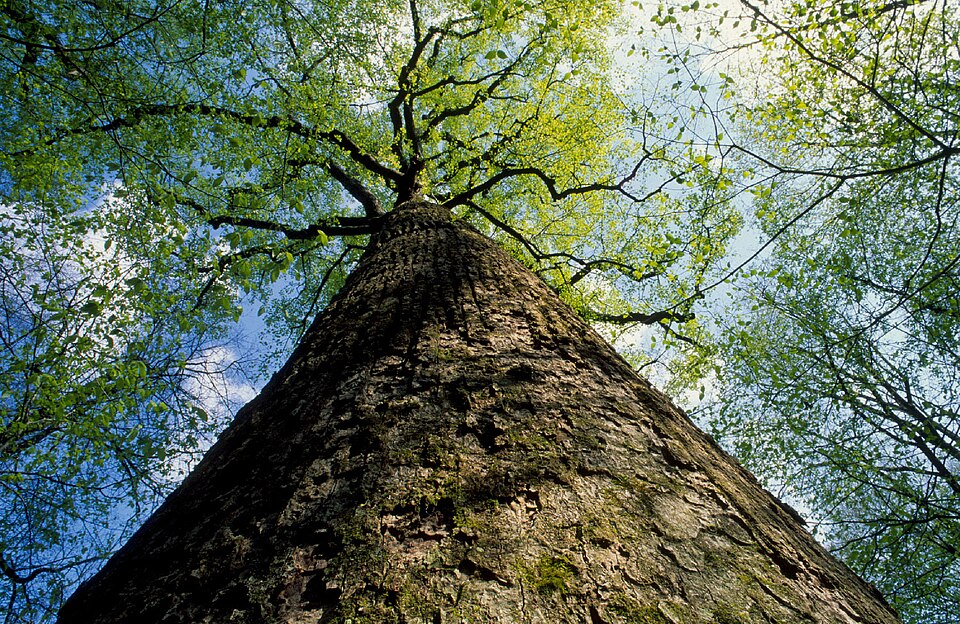
The deepest meaning of the tree, though, is just its shape. A cove-grown yellow-poplar is the closest thing the Eastern hardwood forest has to a redwood: a straight, clean, self-pruned column that holds its diameter far up the stem. Foresters measure other trees against that form. The shape is also a résumé - it is the geometry of a veneer log - and it is why this species converts sunlight into money faster than anything else standing beside it.
Documented History
The board that carried Appalachia after the chestnut fell
To see what the species was before the saw, go to the one place that still has it: Joyce Kilmer Memorial Forest in western North Carolina, a roughly 3,800-acre tract set aside in 1936 as a memorial to the poet of "Trees" and never logged. Its lower coves hold yellow-poplars twenty feet in circumference and centuries old, standing at densities that read like exaggeration until you walk under them. That is not a special grove; that is what rich Appalachian coves looked like generally, and the memorial forest survives because the logging company that owned it went under before the railroad reached the last drainages.
The industrial history is a volume story. Yellow-poplar was cut hard through the great Appalachian timber boom - it was the light, clear, wide board of the trade, sold as whitewood alongside the true poplars of the North - and then history handed it an opening. When the chestnut blight emptied a quarter of the Appalachian canopy in the early twentieth century, yellow-poplar was one of the species that took up the vacated ground, seeding aggressively into openings and growing faster than its competition. A great deal of the poplar a landowner owns today stands where chestnut stood a century ago.
Through the twentieth century it became the bread-and-butter board of the Eastern hardwood industry: furniture frames under the upholstery, drawer sides, interior trim under paint, crossbanding and core stock under walnut and cherry veneer. The trade split it into sapwood and heartwood markets - white sap, the yellow-green heart that ages toward brown, and the purple-black mineral streak that set the discounts - and nearly every use hid the wood inside something else. It has always been the most important hardwood nobody's furniture shows.
The modern chapter keeps the pattern. Yellow-poplar is a leading species by growing-stock volume across the Appalachian states in Forest Service inventory data, it regenerates itself so readily on cutover ground that almost nobody plants it, and engineers keep finding new places to hide it - including structural testing of yellow-poplar cross-laminated timber panels at university and Forest Service labs. A tree that started as canoe stock is being studied as a skyscraper laminate, and it is the same virtue every time: long, straight, clear, and predictable.
Medicinal Record
A fever bark for a blockaded country
Read this first
What follows is a record of what people used and what published sources documented - nothing more. It is not medical advice, it is not a recommendation, and no plant on this page is a treatment for anything. Several of these trees are toxic to livestock and some are toxic to people. Do not eat, brew, or dose anything based on a history page. Talk to a physician, and talk to a veterinarian before your animals get near any of it.
The strongest documented medical chapter for this tree is a wartime substitution. When the Union blockade cut the Confederacy off from imported quinine, the Confederate Surgeon General commissioned Charleston physician Francis Peyre Porcher to catalog home-grown substitutes, and his 1863 Resources of the Southern Fields and Forests lists tulip-poplar bark among the indigenous barks pressed into service against intermittent fevers - alongside dogwood and willow, all of them bitter, none of them quinine. It was scarcity medicine, documented because a government printed it, and it ended with the war that required it.
The older record runs the same direction. Eighteenth- and nineteenth-century American medical botany carried yellow-poplar root and stem bark as a bitter tonic - prescribed in its day for fevers, rheumatism, and worms - and ethnobotanical compilations document Cherokee and other Native American use of bark preparations for a similar spread of complaints. Past tense throughout: bark bitters left practice as chemistry replaced them, and no modern pharmacopoeia carries the tree.
What this section does not contain is also worth a line. Yellow-poplar carries no notable livestock toxicity in the veterinary extension record - no wilted-leaf hazard like black cherry, no bark warning like black locust - which, for a species this common on Southern ground, is genuinely useful information for a landowner planning a felling next to a pasture. The usual counsel stands regardless: the history above is a record, not a recommendation, and questions about animals belong with a veterinarian.
Timber & Owner Value
Volume, clear faces, and the easiest sale in the mountains
On the right ground, nothing else in the Eastern hardwood forest puts on merchantable grade volume as fast. A cove or lower-slope poplar stand grows straight, tall, and clean, holds diameter up the stem, and scales out in big, defect-free sawlogs - which is why a poplar-heavy tract is usually the most straightforward hardwood sale a landowner ever makes. Buyers know exactly what the species does, mills of every size take it, and the veneer market wants the best butts for core and face stock. Poplar is named outright in the Georgia, Arkansas, and Wisconsin mill listings and folded into hardwood everywhere else, so in most states the plywood and moulding buyers are a phone call rather than a lookup. The money per thousand board feet is well below oak or walnut; the thousands of board feet per acre are where poplar wins.
The wood explains the market. At 540 pounds-force Janka and a specific gravity around 0.42, yellow-poplar is soft and light for a hardwood, but it is even-textured, stable once dry, and it machines, glues, nails, and paints as well as anything in the trade. That makes it the paint-grade and hidden-parts wood of the country: mouldings, trim, cabinet interiors, furniture frames, plywood core. It is not a floor and it is not a fence post - it dents under a thumbnail and has little decay resistance - and no honest buyer prices it as either.
Grade on a poplar log is mostly a color and cleanliness conversation. The discounts come from mineral streak - the green-purple-black staining the trade calls simply mineral - from sap-heart color mix in one board, and from the occasional wind shake in old cove trees. The premiums come from length and clear faces, and poplar delivers those more reliably than any other Appalachian species - the log sort on a poplar deck is mostly a color call. A forester marking a poplar stand will also tell you when to wait: the species holds grade well on the stump, and a 16-inch poplar left ten more years on a good site is a materially different check. Scaling a butt log off two diameters and a length is the cheapest way to see that difference for yourself.
Two selling notes pay for the read. First, do not let a poplar cove go for pulp money in a lump-sum brush deal - it happens, usually when a land-clearing job and a timber sale get run as one transaction, and the spread between poplar pulpwood and poplar grade sawtimber is the widest easy money in the mountains. Run the sale as a sale, separately from the clearing job. Second, poplar regenerates itself almost embarrassingly well: seed stored in the litter comes up thick on any opening with bare soil and light, which means the harvest you sell today is also the stand your grandchildren sell, at no planting cost, if the cut is planned that way - which is the one case where the replanting question answers itself.
The wood, by the numbers
- Janka hardness
- 540 lbf
- Specific gravity (12% MC)
- 0.42
- Heartwood decay resistance
- Low - an interior and painted wood
- Growth
- The fastest grade hardwood on a good cove site
- Products
- Millwork, trim, furniture frames, plywood core, veneer
- The discounts
- Mineral streak and sap-heart color mix set the grade
Where this leads
History is worth knowing on its own. If it turned into a question about the timber on your own ground, these are the tools that answer it.
Put a poplar cove out to sealed bids
The spread between poplar pulp money and poplar grade money is the widest easy spread in the mountains, and one walk-up offer never shows it to you. Post the tract once, set a deadline, and buyers bid sealed against each other. Free to post.
Open itFind a consulting forester or a mill
A forester who marks poplar for a living knows which coves are ready and which are still putting on the easiest growth they will ever put on. The directory lists foresters, mills, and buyers by what they do and where they work. Self-listed businesses - call them and judge for yourself.
Open itPlan the stand that follows the cut
Poplar reseeds itself on bare ground and light, so the next stand is mostly a harvest-design question - but site prep, competing stems, and what goes on the ridges above the cove are not. Nurseries, planting crews, and site-prep contractors by species, state, and window.
Open itWhere this came from
AXE USA publishes no research of its own. Everything on these pages is read out of USDA Forest Service, USDA NRCS, land-grant extension, and published historical sources, each linked at the bottom of the page so you can go read the original.
- Silvics of North America, Vol. 2: Liriodendron tulipiferaUSDA Forest Service
- Plant Guide: Tuliptree (Liriodendron tulipifera)USDA NRCS National Plant Data Center
- Resources of the Southern Fields and Forests (Porcher, 1863)Internet Archive
- Wood Handbook: Wood as an Engineering Material (FPL-GTR-282)USDA Forest Products Laboratory