Ulmus americana, U. rubra, U. thomasii
Elm
The tree the country held its meetings under, piped its water through, and then watched die down every Main Street it had planted.
Also called: American elm, white elm, slippery elm, red elm, rock elm
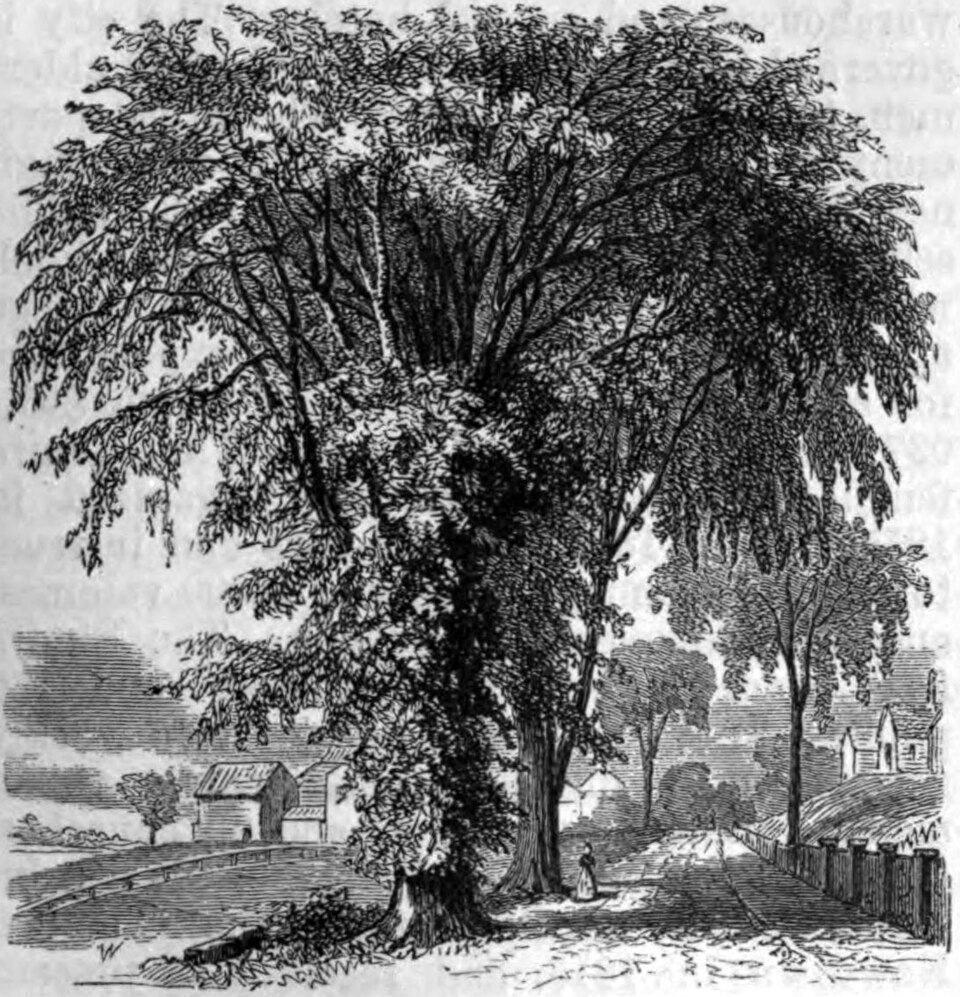
- Native range
- Eastern North America to the Great Plains
- Historic size
- 80-100 ft, vase crown, 4-6 ft diameter
- Janka hardness
- 830 lbf (American), 1,320 (rock elm)
- Status today
- Common as understory; mature trees rare
Old Meaning
Embla, coffin boards, and the meeting tree
In the Norse creation account preserved in the Poetic Edda and retold by Snorri Sturluson, three gods find two pieces of driftwood on a shore and make the first humans out of them. The man is Askr, the ash. The woman is Embla - and Embla is the argument. The name is not transparent the way Askr is, and scholars have read it as elm, as vine, and as a word for the wood you spin fire out of. Elm is the oldest and most common reading and the one that put the tree in every popular retelling. It is a reading, not a settled fact, and anybody who tells you flatly that the first woman was made from an elm is skipping over a hundred and fifty years of philological argument.
European folklore was rougher on the tree. English country rhyme has it that "elm hateth man and waiteth" - a reputation earned honestly, because a healthy elm will drop a heavy limb in still air with no warning and no visible defect. Arborists still call the species out for it. Elm was also the standard coffin board in Britain for centuries, chosen because it resists rot in damp ground and because it will not split when nailed. A tree that kills you and then boxes you up gets a dark reputation and keeps it.
America inverted the whole thing. Here the elm became the civic tree - the one at the center of the common, the one the town met under, the one a treaty or a protest got its name from. That happened for boring practical reasons: the vase-shaped crown arches over a street without needing to be limbed up, and the tree tolerates compacted soil, road salt, and city air better than almost anything else that gets that big. But the meaning that grew on top of the horticulture is the meaning that stuck, and it is why the two most famous individual trees in early American history were both elms.
Documented History
A tree in Boston, a tree at Shackamaxon, and a shipment of veneer logs
On the morning of 14 August 1765, an effigy of Andrew Oliver - the man appointed to distribute stamps in Massachusetts under the new Stamp Act - was found hanging from a large elm at the corner of Essex and Orange Street in Boston. The crowd that gathered under it that day and the crowds that gathered after made the tree the fixed point of colonial resistance in the city. Oliver resigned. The Sons of Liberty met there so regularly that the ground under the branches got its own name, Liberty Hall, and other towns started designating liberty trees of their own. In August 1775, British troops and loyalists cut it down and split it for firewood, which tells you exactly how much the tree had come to mean.
The other famous one stood at Shackamaxon on the Delaware, north of what is now Philadelphia. Tradition holds that William Penn concluded his treaty with the Lenape under it in 1682, and Benjamin West's painting made that scene one of the founding images of the country. The documentary record for that specific tree is thin - the treaty is well attested, the elm is tradition layered on afterward. What is documented is the tree itself: it blew down in a storm in 1810, and the people who measured it put it around 24 feet in circumference and counted rings back well past the 1680s. Relics were cut from it and are still in Philadelphia collections.
The elm also plumbed the country. Before cast iron, cities moved water through bored logs - a log with a hole augered down its length, one end tapered to drive into the socket of the next. Elm was the preferred species for it in London and across northern Europe, for the same reason it made good coffins and good chair seats: the interlocked grain does not split when you bore it, and the wood does not rot when it stays permanently wet. American cities did the same thing with elm and pitch pine. Utility crews still dig up sections of bored wooden main under old streets.
Then came 1928. A shipment of elm burl veneer logs from Europe landed at an Ohio furniture plant carrying the fungus and the beetles that spread it. Dutch elm disease is called Dutch because Dutch pathologists - Bea Schwarz and Christine Buisman among them - identified it in the 1920s, not because it came from the Netherlands. The fungus Ophiostoma ulmi, and later the far more aggressive Ophiostoma novo-ulmi, is carried tree to tree by elm bark beetles and moves underground between neighbors through grafted roots. That root-graft route is why an entire planted street died in sequence, one house at a time, and why the loss registered as a national event rather than a forestry statistic.
Tens of millions of American elms died - the most-cited figure for North America runs to roughly 77 million by the late 1970s. The species itself did not go the way of the chestnut. Elm seeds prolifically and grows fast, so it persists everywhere as a young understory tree, reproducing before it gets big enough for the beetles to find interesting. What was lost was the mature tree and the street it shaded. Resistant selections - 'Valley Forge', 'Princeton', 'New Harmony', 'Jefferson' - came out of USDA and National Arboretum work and are planted today, but a resistant cultivar is not a restored forest.
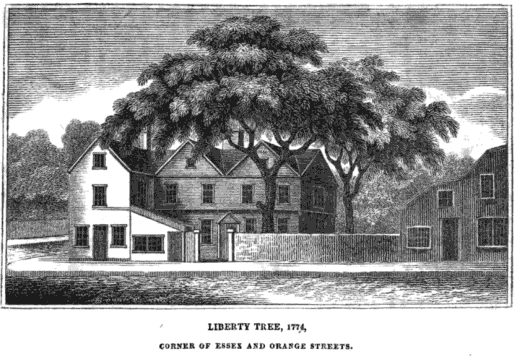
Boston's Liberty Tree, engraved for Snow's History of Boston in 1828. British troops and loyalists cut it for firewood in August 1775.
Caleb Snow, A History of Boston (1828). Public domain.
Medicinal Record
Slippery elm is the one with the record
Read this first
What follows is a record of what people used and what published sources documented - nothing more. It is not medical advice, it is not a recommendation, and no plant on this page is a treatment for anything. Several of these trees are toxic to livestock and some are toxic to people. Do not eat, brew, or dose anything based on a history page. Talk to a physician, and talk to a veterinarian before your animals get near any of it.
American elm barely appears in the medical literature. Slippery elm - Ulmus rubra, called red elm on a log deck - appears constantly, and the reason is one physical property: the inner bark is heavily mucilaginous. Wet it and it turns slick and gelatinous. Every documented use follows from that.
The USDA NRCS plant guide for the species records the ethnobotanical history in detail, and it is worth reading in the original. The Iroquois scraped the bark and combined it with other plants for infected and swollen glands, and made an inner-bark wash for sore eyes. The Menomini took the inner bark in a tea as a physic and used it in poultices for sores on the body; the Meskwaki used the same poultice, and Meskwaki women drank a bark tea to ease childbirth. The Ojibwe used it for sore throats. The Dakota, Omaha-Ponca, and other tribes boiled the fresh inner bark and drank the decoction as a laxative. That same guide records, plainly, that these uses were taught to arriving settlers.
From there it entered American pharmacy and stayed. Slippery elm bark was an official drug in the United States Pharmacopoeia, and it is one of the very few botanicals from that era still sold in more or less its historic form - the NRCS guide notes it is stocked in health food stores and used for sore throats, coughs, other bronchial complaints, and as a laxative. It is a common ingredient in throat lozenges today.
The bark also fed and clothed people, which is the part the medical framing tends to lose. The Meskwaki used it for the sides of winter houses and for roofing; the Dakota, Omaha-Ponca, Winnebago, and Pawnee twisted the inner bark fiber into rope and cord; others wove it into bags and storage baskets. Bark stripping kills the tree, and stripping it from a live standing elm on somebody else's ground is theft of merchantable timber, which is a point worth making out loud on a page that timber buyers read.
Timber & Owner Value
The wood that will not split
Elm's defining property is interlocked grain. The fibers run in alternating directions, and the practical result is a wood that is close to impossible to split along its length - miserable firewood whatever its BTU rating says, unbeatable for anything that has to take a nail, a spoke, or a hoop without coming apart. That single trait built its entire historic market: wagon-wheel hubs, chair seats, barrel hoops and slack-cooperage staves, crates and boxes, and thin veneer for fruit baskets. Rock elm, the hardest of the three at about 1,320 lbf, went into ship frames and agricultural implements where a piece had to bend hard without failing.
American elm runs about 830 lbf on the Janka scale and slippery elm about 860 - both firmly in the mid-range of American hardwoods, well under white oak at 1,350. Neither is durable in ground contact. What elm does that few woods do is survive being permanently submerged, which is exactly why it made water mains and dock piling and why it is a poor choice for a fence post.
The market today is thin and local. Most elm cut in the South moves as mixed hardwood into pallet and crating stock, and a mill quoting your tract will price it that way without asking. Only a few agency directories name elm at all - Arkansas and Wisconsin do - which tells you something about how thin the specialty demand really is. Red elm is the exception worth knowing: it has a warm reddish-brown color, works and finishes better than the white elms, and has a real following among furniture makers, turners, and slab buyers. It sells by the log to the right person and by the ton to the wrong one, and the difference is entirely whether you knew to separate it.
Practical guidance for a tract in the South. Live, straight red elm in a hardwood stand is worth calling out to your buyer as its own line item rather than letting it disappear into the mixed-hardwood tally - the same conversation you would have about a veneer-grade white oak, and the reason writing the sale down before anyone bids pays for itself. Standing dead elm is a different problem: it is a hazard tree, it deteriorates fast once the bark slips, and it is worth removing on safety grounds before it is worth anything on a scale ticket. And if elm on your ground is dying in a line, that is the root-graft pattern, and it is the reason cutting the graft between a dying tree and its neighbor is standard practice.
The wood, by the numbers
- Janka - American elm
- 830 lbf
- Janka - slippery / red elm
- 860 lbf
- Janka - rock elm
- 1,320 lbf
- Specific gravity (12% MC)
- 0.50 American, 0.53 slippery
- Splitting resistance
- Very high - interlocked grain
- Decay resistance
- Low in ground contact, excellent submerged
- Market today
- Mixed hardwood; red elm sells to specialty buyers
Where this leads
History is worth knowing on its own. If it turned into a question about the timber on your own ground, these are the tools that answer it.
Sell the hardwood, and itemize the red elm
Post the tract and take sealed bids from buyers and loggers against your own deadline. Listing the good red elm separately from the mixed hardwood is a line item you control when you write the sale.
Open itGet bids on hazard trees and clearing
Standing dead elm near a house, a lane, or a fence line is a removal job, not a timber sale. Crews working your county bid it sealed, and merchantable wood on the tract can offset the cost.
Open itFind a sawyer who wants red elm
Mills, portable sawyers, and buyers listed by trade and state. These businesses list themselves. AXE USA does not screen or endorse them - the directory tells you who is out there, and the phone call is yours to make.
Open itWhere this came from
AXE USA publishes no research of its own. Everything on these pages is read out of USDA Forest Service, USDA NRCS, land-grant extension, and published historical sources, each linked at the bottom of the page so you can go read the original.
- Silvics of North America, Vol. 2: Ulmus americanaUSDA Forest Service
- Plant Guide: Slippery Elm (Ulmus rubra)USDA NRCS National Plant Data Center
- Dutch Elm Disease - Plant Disease LessonsAmerican Phytopathological Society
- The Liberty TreeNational Park Service, Boston National Historical Park
- Wood Handbook: Wood as an Engineering Material (FPL-GTR-282)USDA Forest Products Laboratory