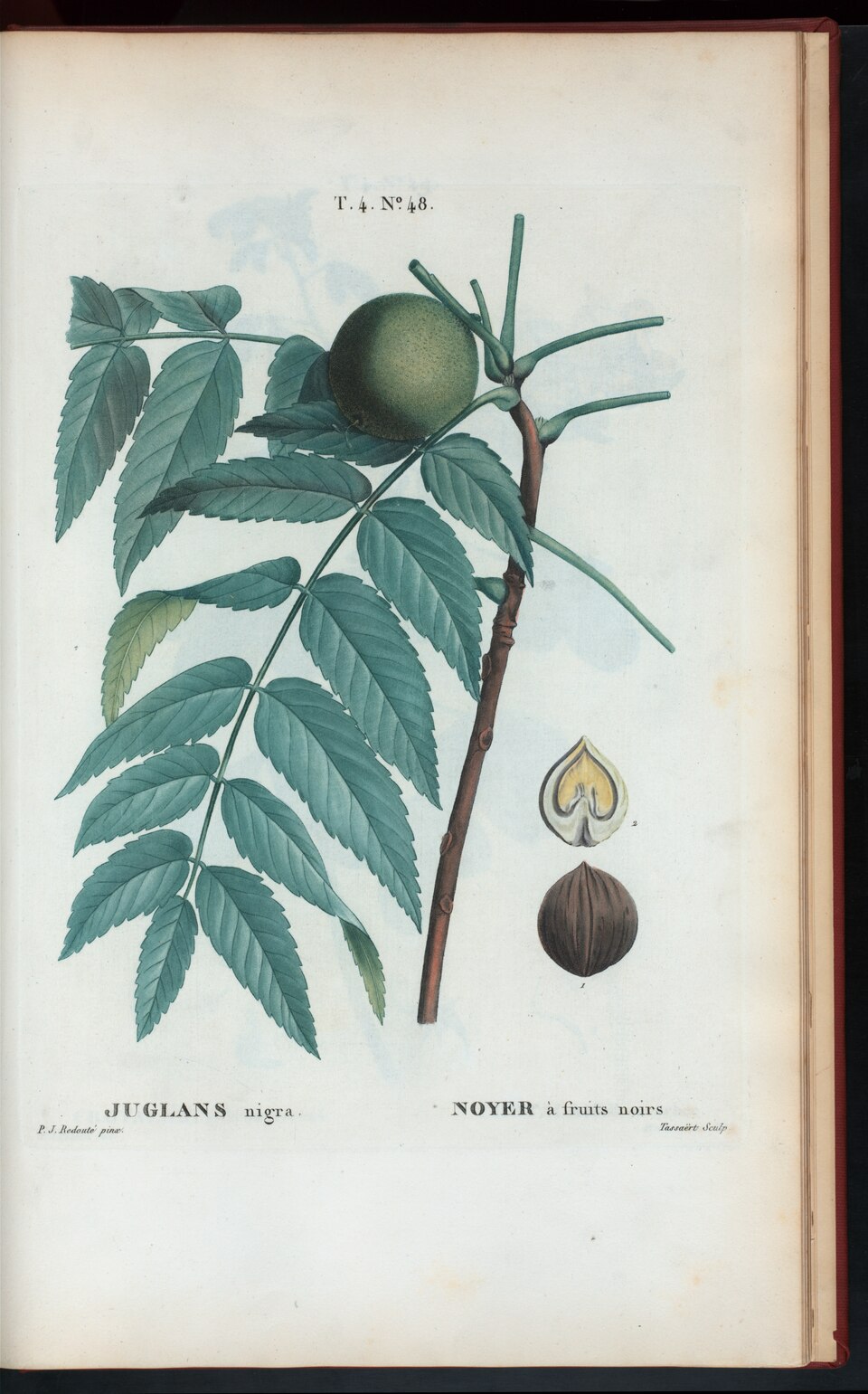
Juglans nigra
Black Walnut
The most valuable common tree in the Eastern woods, log for log - and the one most often bought off a farm for a fraction of what the second bidder would have paid.
Also called: American walnut, eastern black walnut - "walnut" without qualification on any American log deck
- Native range
- New England to Georgia, west to the Great Plains - best in the Midwest and Upper South
- Mature size
- 70-100 ft; a veneer tree is 18-30 in through and clean
- Janka hardness
- 1,010 lbf
- Status today
- Common on fencerows and bottoms; thousand cankers disease is the watch item
Old Meaning
The bank account standing in the yard
Black walnut is the tree American farm families planted on purpose and defended by name. Across the Midwest and the Upper South it stands at old homesites, along lanes, and down fencerows because somebody put it there or spared it there - a shade tree that paid rent in nuts every fall and appreciated like land the whole time. The habit of speaking of a big walnut the way you would speak of a savings account is older than the veneer market that eventually made it literally true.
The nuts were the working half of the old meaning. Black walnuts are oily, strong-flavored, and armored in a husk that dyes everything it touches; families hulled them by the bushel - under a board, under a boot, under a car tire in the later years - and the meats went into cakes and ice cream while the hulls went into the dye pot. Walnut and butternut hulls colored the homespun of the frontier and, by tradition, the butternut-brown uniforms that named Confederate soldiers. The hand stain is the honest version of the story: anyone who has husked a bushel bare-handed carried the evidence for two weeks.
The tree also taught American gardeners a chemistry lesson centuries before the chemistry had a name. Gardens fail under a walnut - tomatoes wilt, apples sulk - and the old observation is now the textbook example of allelopathy: the tree's tissues carry juglone, a compound that suppresses competing plants in the root zone. It is why the fencerow walnut so often stands handsome and alone, and it belongs in this section because it shaped where people planted the tree long before anyone could say why.
And the heartwood carried the meaning that outlasted the farm: rich chocolate-brown, straight-grained, strong for its weight, and stable once dry. Walnut has signaled money in American rooms since the parlor-furniture era, and it is the only common native species whose reputation never needed fashion's help twice - every generation rediscovers it and prices it accordingly.
Documented History
Gunstocks, veneer money, and thieves with chainsaws
The military history is a materials story. American service rifles wore walnut for most of two centuries - the Springfield 1903 and the M1 Garand among them - because the wood holds dimensions through weather, absorbs recoil without cracking, machines to close tolerances, and does not splinter dangerously when struck. Both world wars ran organized walnut procurement drives, and wartime buying reached into farm woodlots and fencerows across the range. A great many of the biggest walnuts a landowner's grandfather remembered left the country in a rifle crate.
The veneer trade wrote the price history. A veneer-grade walnut - long, straight, round, defect-free, dark-hearted - is sliced into leaves measured in fractions of a millimeter, so a single log becomes acres of furniture and cabinet faces, and buyers price it accordingly: single trees selling at auction for five figures have been documented since the 1970s. That era also produced the walnut rustling the newspapers loved - trees cut out of yards, parks, and cemeteries at night, fencerow trees bought from a tenant while the owner was away, and press accounts of thieves lifting logs out by helicopter. The helicopter stories are period legend more than court record; the thefts and prosecutions were entirely real, and walnut theft still happens for the same arithmetic.
The plantation chapter is a lesson in patience and site. State nurseries and groups like the Walnut Council promoted walnut planting hard through the twentieth century, and the honest summary of the results is that walnut forgives nothing: it wants deep, well-drained, fertile bottomland ground, early weed control, and decades of pruning discipline, and on any lesser site it grows into a limby disappointment. Sixty to eighty years separates a planted seedling from a veneer log even when everything is done right. People still plant it - it is the classic grandchildren's crop - but the ones who succeed chose the ground first.
The current chapter is a disease watch. Thousand cankers disease - a bark-beetle-carried fungus, Geosmithia morbida, spread by the walnut twig beetle - was described killing walnuts in the West in the 2000s and was found in Tennessee in 2010, inside the tree's native range. Quarantines on walnut wood movement followed in several states. It has not rewritten the Eastern walnut resource the way blight rewrote chestnut, and the honest status is exactly that: documented, monitored, and worth asking about before moving walnut logs or firewood across state lines.
Medicinal Record
Green hulls, bitter bark, and a warning written for horses
Read this first
What follows is a record of what people used and what published sources documented - nothing more. It is not medical advice, it is not a recommendation, and no plant on this page is a treatment for anything. Several of these trees are toxic to livestock and some are toxic to people. Do not eat, brew, or dose anything based on a history page. Talk to a physician, and talk to a veterinarian before your animals get near any of it.
The walnut entry in the American medical record is mostly a hull entry. Nineteenth-century domestic and eclectic practice used preparations of the green hull against intestinal worms and for skin complaints - ringworm chief among them - and the inner bark was carried as a mild purgative. Ethnobotanical compilations document parallel Native American uses of bark and hulls. All of it is reported here in the past tense: the preparations left practice with the rest of frontier pharmacy, and none of them belongs in a modern medicine cabinet on the strength of a history page.
What gives the old uses their footnote of plausibility is the same chemistry that kills tomatoes. Juglone is genuinely biologically active - plant-suppressing, pigment-staining, and toxic in the wrong context - which is precisely why the right response to this paragraph is curiosity rather than experiment. A compound strong enough to have been used against ringworm is strong enough to deserve a physician's opinion, and that is where the subject belongs.
The one walnut warning that is current, documented, and worth repeating verbatim to a neighbor is veterinary. Black walnut shavings or sawdust in horse bedding cause laminitis - a serious, fast-onset hoof disease - and extension veterinary publications document cases from bedding contaminated with even a modest fraction of walnut. A landowner milling walnut on the farm, or giving sawdust away, should know that rule and say it out loud. As everywhere on these pages: animals near any of it is a veterinarian's conversation, not a website's.
Timber & Owner Value
One butt log, one nail, and the case for a second bid
Walnut value is butt-log value. The veneer buyer wants the first eight to sixteen feet: straight, round, centered dark heart, no seams, no catfaces, no shake - and no metal. Nothing else on your ground rewards the log sort like this: one butt log can carry most of a tract's value. That last one is the executioner of yard and fencerow walnut, which is exactly where the biggest trees stand: one clothesline hook, one insulator nail, one strand of grown-over fence wire, and a five-figure log becomes a sawlog with a story. Buyers scan for metal because slicer knives are expensive; an owner who knows a tree's yard history should say so honestly and price expectations accordingly. Walnut is one of the few species agency mill lists name outright: Arkansas, Wisconsin, and Georgia all publish it, which is a useful starting list when the buyer in your driveway is the only one you have talked to.
The grade ladder is steeper in walnut than in any other American species - veneer over grade lumber by multiples, grade lumber over the rest by multiples again - and the market is not local the way tie and pallet markets are. Veneer buyers travel across state lines for single loads and always have. The practical meaning for a landowner: the buyer standing in your driveway is not the market, he is one point in it, and walnut is the species where the second and third sealed bid most often carry shocking news. Posting the trees to a sealed deadline costs nothing and is the only way to find out what the travelling buyer would have paid.
The wood under all this money: 1,010 pounds-force Janka, specific gravity around 0.55, strong for its weight, stable once dry, machines beautifully, and the heartwood is naturally durable - the Forest Products Laboratory rates it among the durable American hardwoods, which is why walnut gunstocks and walnut furniture outlive their makers. The sapwood is pale and the trade steams lumber to blend it; a log's heart-to-sap ratio is part of its price.
Two owner decisions round out the page. First, scattered trees are the norm - most farms hold one to five sellable walnuts, not a stand - and single-tree sales are where owners get hurt worst, because there is no cruise, no comparison, and a check that sounds large against no reference at all. Treat even three fencerow walnuts as a sale worth a forester's hour and a sealed deadline, and read how a timber sale is actually written before the first handshake - a single-tree sale goes wrong in the same places a forty-acre one does. Second, if you hold good bottomland with none on it, planted walnut is the classic inheritance decision: pick the ground ruthlessly, prune early and often, keep cattle off the roots, and write the grandchildren's names on the management plan, because the check is theirs.
The wood, by the numbers
- Janka hardness
- 1,010 lbf
- Specific gravity (12% MC)
- 0.55
- Heartwood decay resistance
- Durable - the classic gunstock and furniture heartwood
- The money grade
- Veneer: straight, round, dark-hearted, metal-free butt logs
- Products
- Veneer, gunstocks, furniture, grade lumber
- The killer
- Embedded metal - yard and fencerow trees fail on it
Where this leads
History is worth knowing on its own. If it turned into a question about the timber on your own ground, these are the tools that answer it.
Put walnut out to sealed bids - especially a few trees
Walnut is the species where the second bid most often carries shocking news, and single-tree sales against no comparison are where owners get hurt worst. Post once, set a deadline, and buyers bid sealed against each other. Free to post.
Open itFind a consulting forester or a mill
An hour of a forester's time on three fencerow walnuts can be the best-paid hour on the whole farm. The directory lists foresters, mills, and buyers by what they do and where they work. Self-listed businesses - call them and judge for yourself.
Open itPlant the grandchildren's veneer
Walnut forgives nothing about site, and the ground decision matters more than the seedling. Nurseries, planting crews, and site-prep contractors by species, state, and planting window - and the sealed-quote board for the work itself.
Open itWhere this came from
AXE USA publishes no research of its own. Everything on these pages is read out of USDA Forest Service, USDA NRCS, land-grant extension, and published historical sources, each linked at the bottom of the page so you can go read the original.
- Silvics of North America, Vol. 2: Juglans nigraUSDA Forest Service
- Plant Guide: Black Walnut (Juglans nigra)USDA NRCS National Plant Data Center
- Fire Effects Information System: Juglans nigraUSDA Forest Service
- Wood Handbook: Wood as an Engineering Material (FPL-GTR-282)USDA Forest Products Laboratory