Taxodium distichum
Bald Cypress
A conifer that drops its needles, stands in water that rots everything else, and lives longer than any other tree in the East - the "wood eternal" of the old lumber trade.
Also called: Baldcypress in the Forest Service's one-word spelling, swamp cypress, and just "cypress" across the whole Gulf South - "pecky cypress" is the fungus-tracked wood, not a different tree
- Native range
- Delaware down the coast to Texas, up the Mississippi Valley to southern Illinois
- Mature size
- 100-120 ft historic; old-growth trunks 6-12 ft through above the buttress
- Janka hardness
- 510 lbf - a true softwood in every sense
- Status today
- Common as second growth; the old-growth swamps are essentially gone
Old Meaning
The tree that breaks every rule in the glossary
Bald cypress is the exception tree, and the name confesses it. It is a conifer - cone-bearing, needle-leaved, sold as a softwood - that turns rust-orange every fall and drops every needle, standing bald all winter in a landscape of evergreen pines. The terminology page on this site needs exactly one tree to prove that deciduous and conifer are not opposites, and this is the tree. It is also, botanically, a redwood relative - the same family as the sequoias - which is fitting for a species that grows to their kind of age if nothing cuts it.
The age is not folklore. In 2019, researchers coring bald cypress along North Carolina's Black River published trees more than 2,600 years old - one at 2,624 years - making the species the oldest known wetland tree on earth and the oldest documented trees of any kind in eastern North America. Florida's famous Senator cypress, estimated around 3,500 years before it burned in 2012, suggests the cored trees are not even the ceiling. A landowner standing in an old cypress bottom may be standing under the oldest living things east of the Rockies, and the humility that thought produces is the correct professional posture.
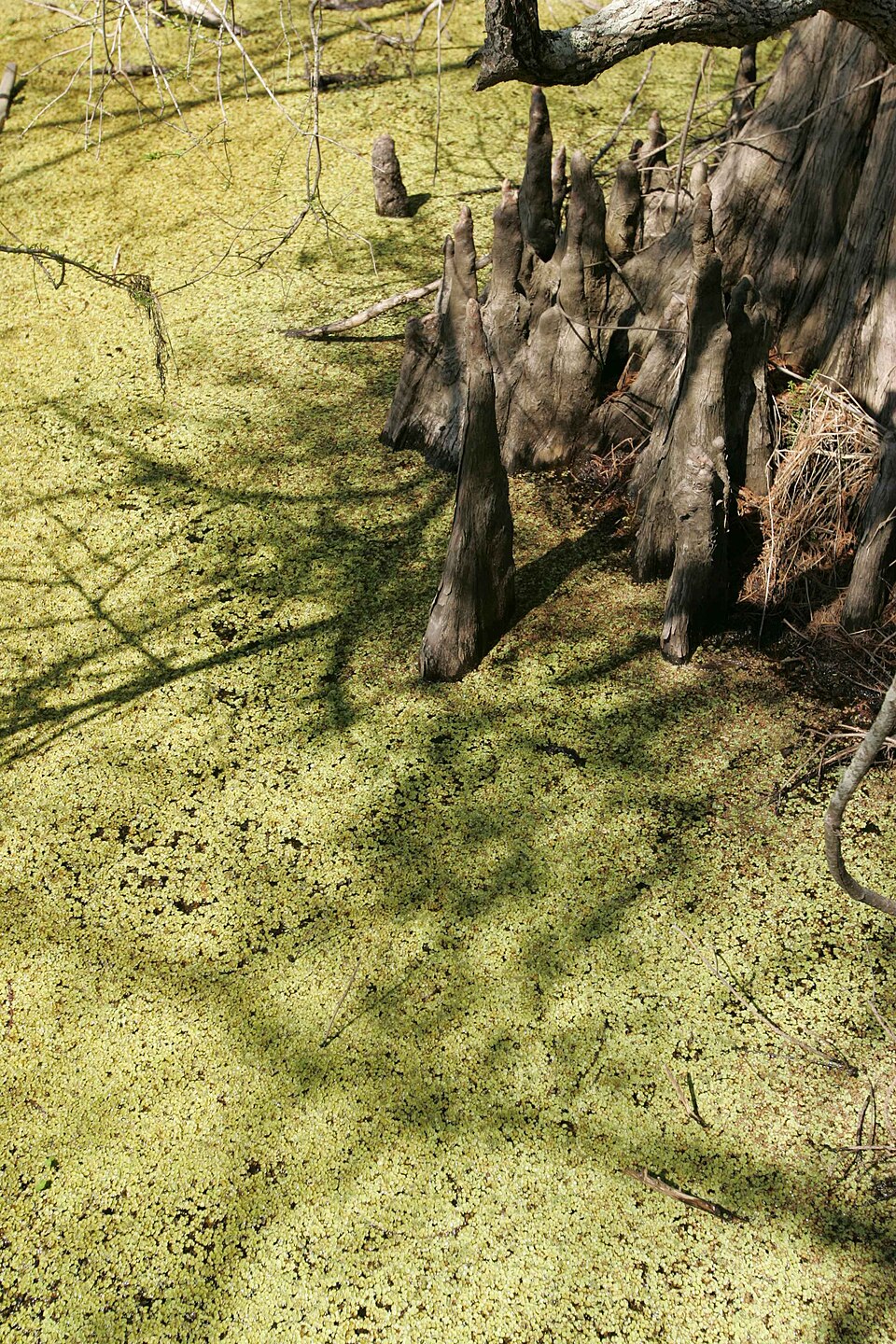
The knees are the tree's signature and the swamp's furniture: woody cones rising out of the water from the root system, sometimes ankle-high, sometimes waist-high. What they are for is a genuinely open question - the aeration explanation repeated in every field guide has never been experimentally confirmed, and the Forest Service's own silvics literature says so - and this page will not pretend the matter is settled. What they meant in practice: knees marked ground too wet to farm, and cut and hollowed knees became the beehives, buckets, and curio lamps of the swamp-country economy.
To the people of the Gulf South the tree was shelter and boat in one. Choctaw and other Southeastern peoples made dugouts of it; the Acadians built their cottages of it; and cypress board siding, cisterns, and shingles defined the building tradition of south Louisiana so completely that the state eventually named it the state tree. A tree that grows in water, works easily, and refuses to rot was not one material among several down there - it was the material.
Documented History
Girdled a year ahead, floated out, and gone in fifty years
The industrial story is the strangest logging story in the country, because the trees stood in water and green cypress does not float. The solution the industry settled on: crews girdled the standing trees months to a year ahead of the cut, let them die and dry on the stump until the wood would float, then felled them into the flood and rafted them out. Pull-boats - steam winches on barges, dragging logs through the swamp on cables - and dredged canals did the rest. The canal scars are still visible in Louisiana swamps from the air a century later.
The boom ran roughly from the 1880s to the 1920s, peaked around 1913 when Louisiana ranked among the top lumber states in the nation, and then did what every cut-out-and-get-out boom did: it ran out of old growth and collapsed by the mid-1930s. What it shipped, the trade called the wood eternal - dense, oily old-growth heartwood that went into greenhouses, water tanks, silos, coffins, boats, siding, and shingles precisely because it would not rot. The phrase was marketing, and it was also, for that wood, essentially true.
The fine print on "eternal" matters to anyone buying or selling cypress today. The rot resistance lived in old heartwood, laid down over centuries; the second-growth cypress on the market now is mostly faster-grown, sapwood-heavy, and only moderately durable - the Forest Products Laboratory draws exactly that old-growth versus second-growth distinction in print. The premium salvage trade knows it too: sinker cypress, boom-era logs raised off river and swamp bottoms after a century underwater, sells at reclaimed-lumber prices for the same reason barn-frame chestnut does.
One more piece of the old growth survives in a form buyers pay extra for: pecky cypress, heartwood tunneled into long open pockets by a fungus that attacks living old trees and dies with the tree. It was a defect until decorators decided it was a look; it has been a paneling premium for decades since. The old swamps themselves survive mainly as public showpieces - Corkscrew Swamp in Florida, the Black River stands in North Carolina - and as the second-growth bottoms that came back on cutover ground, which is what nearly every cypress a landowner owns today actually is.
Medicinal Record
A thin record, honestly reported
Read this first
What follows is a record of what people used and what published sources documented - nothing more. It is not medical advice, it is not a recommendation, and no plant on this page is a treatment for anything. Several of these trees are toxic to livestock and some are toxic to people. Do not eat, brew, or dose anything based on a history page. Talk to a physician, and talk to a veterinarian before your animals get near any of it.
Bald cypress keeps almost no place in the American medical record, and this page reports that as the finding rather than papering over it. The ethnobotanical compilations carry a short list - Choctaw use of crushed cone and resin preparations on wounds and skin complaints appears in the standard references, with scattered similar entries elsewhere in the Southeast - and the nineteenth-century pharmacy literature that carried chestnut leaf and walnut hulls carried essentially nothing of cypress. A tree can matter enormously and medically hardly at all; cypress was boat, house, and cistern, and the folk record spent its attention there.
All of it is past tense, none of it carries a dose, and the general rule of this section binds here with no exceptions: a history page is not a reason to prepare anything, and resinous conifer preparations in particular belong in the record, not in a kitchen.
The practical cautions on this species are environmental rather than chemical. No notable livestock toxicity follows bald cypress in the veterinary extension record, but everything around the tree is regulated water: cypress stands are wetlands almost by definition, felling in them intersects state and federal water rules, and the knees themselves are the tree's living root system - cutting them for craftwood wounds the tree and, on someone else's land, is plain theft. The animal questions go to a veterinarian; the wetland questions go to a forester who works swamps, and the next section says why that matters to the check.
Timber & Owner Value
Wet ground, wetland rules, and wood sold on its reputation
Cypress money is specialty money. The wood is light and soft - 510 pounds-force Janka, specific gravity around 0.46 - but it works cleanly, holds paint and finish, and sells on the strength of a rot-proof reputation the old growth earned: exterior siding, porch material, shutters, beams, paneling, and the pecky grades that decorators pay up for. It routinely brings more than the pine it shares the South with, and it is one of the handful of species agency mill directories name outright - the Arkansas and Georgia listings publish cypress, while the rest of the South files the same plants under softwood or hardwood, and the honest asterisk from the Forest Products Laboratory belongs in the listing: second-growth heartwood is moderately durable, not eternal, and a seller who says so reads as someone worth doing business with.
The harvest itself is what makes cypress unlike every other page in this section. The trees stand in water or on ground that is wet most of the year, which means the sale lives or dies on logistics and law together: dry-season or frozen-ground windows, matting or specialized equipment, state forestry best-management practices for streamside and wetland zones, and - depending on the site and the state - permitting questions that upland sales never meet. A buyer who logs swamps is a different animal from a buyer who logs ridges, and the first forester question on a cypress tract is which kind is bidding - which is an argument for a written sale with a bid deadline rather than the offer that shows up at the gate.
Regeneration is the quiet trap in a cypress sale. The species seeds only onto mud - seed will not germinate under standing water and seedlings drown if flooded over their tops - and in much of the modern South, altered flooding and heavy deer and nutria pressure mean a cutover cypress bottom does not reliably come back to cypress. A harvest plan that leaves seed trees and times the cut to the water is the difference between a stand your grandchildren sell and a permanent conversion to tupelo brush, and on a bottom that will not seed itself planting is the only other route back; state extension guidance says so plainly, and a landowner should hear it before the first bid, not after.
Two more lines for the ledger. First, the standing swamp earns without a saw: cypress bottoms are duck timber, deer cover, and some of the most leasable hunting ground in the South, and flooded-timber waterfowl leases price by the acre in ways an upland pine stand never will. Second, if there is a boom-era history on the water - old canals, raft routes - sinker-log salvage is a real niche with its own state permitting; it is specialized work, but it is also money lying on the bottom that a landowner should at least know is there before signing anything that transfers rights to it. Both of those belong with the income a stand throws off before any harvest rather than in the timber column.
The wood, by the numbers
- Janka hardness
- 510 lbf
- Specific gravity (12% MC)
- 0.46
- Heartwood decay resistance
- Old growth: highly durable. Second growth: moderate
- The premium grades
- Pecky cypress, sinker salvage, all-heart exterior stock
- Products
- Siding, beams, paneling, shutters, boats, mulch at the bottom of the market
- The complication
- Wetland ground - access windows, BMPs, and permits shape every sale
Where this leads
History is worth knowing on its own. If it turned into a question about the timber on your own ground, these are the tools that answer it.
Put a cypress bottom in front of the right buyers
Swamp logging is specialty work, and the buyer who happens to knock is rarely the one equipped for it. Post the tract once, say the ground is wet, set a deadline, and let the buyers who log water bid sealed against each other. Free to post.
Open itFind a forester who works wetlands
Water rules, seed-tree planning, and dry-season logistics make cypress the last species to sell without professional help. The directory lists foresters, mills, and buyers by what they do and where they work. Self-listed businesses - call them and judge for yourself.
Open itLease the swamp while it grows
Flooded cypress timber is duck country, and waterfowl leases price accordingly. If the stand needs decades - and cypress always needs decades - the water under it can earn now. Leases list by state, acreage, and game.
Open itWhere this came from
AXE USA publishes no research of its own. Everything on these pages is read out of USDA Forest Service, USDA NRCS, land-grant extension, and published historical sources, each linked at the bottom of the page so you can go read the original.
- Silvics of North America, Vol. 1: Taxodium distichumUSDA Forest Service
- Plant Guide: Baldcypress (Taxodium distichum)USDA NRCS National Plant Data Center
- Longevity, climate sensitivity, and conservation status of wetland trees at Black River, North Carolina (Stahle et al., 2019)Environmental Research Communications
- Wood Handbook: Wood as an Engineering Material (FPL-GTR-282)USDA Forest Products Laboratory